In industrial metal procurement and electromagnetic manufacturing, material terminology frequently creates confusion. Engineers and sourcing specialists often ask: Are “silicon steel” and “electrical steel” identical materials? Can low-cost mild carbon steel ever substitute for silicon steel in motor or transformer cores?
While silicon steel and electrical steel are essentially synonymous terms describing the same family of functional alloys, both differ radically from conventional carbon steel plates and sheets. Understanding the delicate metallurgical trade-offs between silicon content, magnetic permeability, core loss, and mechanical workability is vital to preventing catastrophic energy waste and component overheating. Below is the definitive metallurgical comparison guide, supported by mill manufacturing data from Megatop Group’s electrical steel division.
Is Silicon Steel the Same as Electrical Steel? Terminology Explained
Yes, silicon steel and electrical steel refer to the exact same category of soft magnetic iron-silicon alloys; “silicon steel” is the traditional metallurgical name denoting its primary alloying element, while “electrical steel” is the formal engineering standard term used by ASTM, IEC, and EN specifications.
In global trade, the terms are utilized interchangeably:
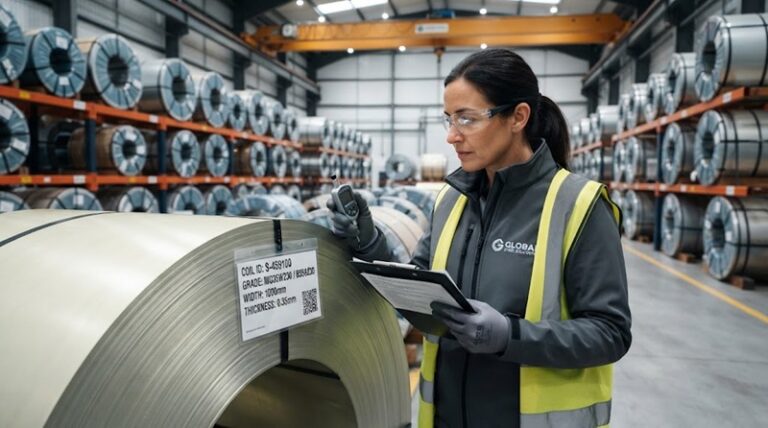
- Silicon Steel: The historical industry term highlighting the intentional addition of 0.5% to 3.5% silicon to pure iron. In workshops and trading desks, personnel often refer to raw master coils or stamped laminations as “silicon steel sheets.”
- Electrical Steel: The standardized engineering designation adopted by global bodies such as ASTM International, the International Electrotechnical Commission (IEC), and European Standards (EN). Formal technical literature categorizes this material under Cold Rolled Grain Oriented (CRGO) and Cold Rolled Non-Oriented (CRNGO) electrical steels.
In contrast, Carbon Steel represents structural and mechanical steels where carbon (0.05% to 2.0%) is the principal alloying agent used to achieve tensile strength and hardness, with silicon present only in trace deoxidizing quantities (typically < 0.35%).
Chemical Composition Breakdown: Why Is Silicon Added to Iron?
Silicon is added to iron primarily to dramatically increase electrical volume resistivity, which suppresses parasitic eddy current losses, while carbon content must be suppressed below 0.005% to prevent magnetic aging.
The chemical composition of electrical steel is engineered entirely around electromagnetic behavior rather than mechanical load-bearing capacity:
- Elevating Electrical Resistivity: Pure iron has an electrical resistivity of approximately 10 µΩ·cm. Adding 3.0% silicon increases electrical resistivity nearly fivefold to roughly 45 to 50 µΩ·cm. Because eddy current loss is inversely proportional to electrical resistivity ($P_e \propto 1/\rho$), higher silicon content drastically reduces heat dissipation during rapid AC magnetic reversals.
- Reducing Magnetocrystalline Anisotropy and Magnetostriction: Silicon lowers the magnetocrystalline anisotropy energy of the iron matrix, allowing magnetic domain walls to move with less resistance. This significantly reduces hysteresis loss and minimizes audible transformer humming noise caused by magnetostriction.
- Ultra-Low Carbon Control (< 0.005% C): In carbon steel, carbon provides hardness and yield strength. In electrical steel, interstitial carbon atoms are severe metallurgical defects that pin magnetic domain walls, causing “magnetic aging” (a gradual deterioration of core loss over months of operation). Modern mills use vacuum degassing and decarburization annealing to reduce carbon levels to near zero.
Magnetic Performance: Electrical Steel vs Ordinary Low-Carbon Steel
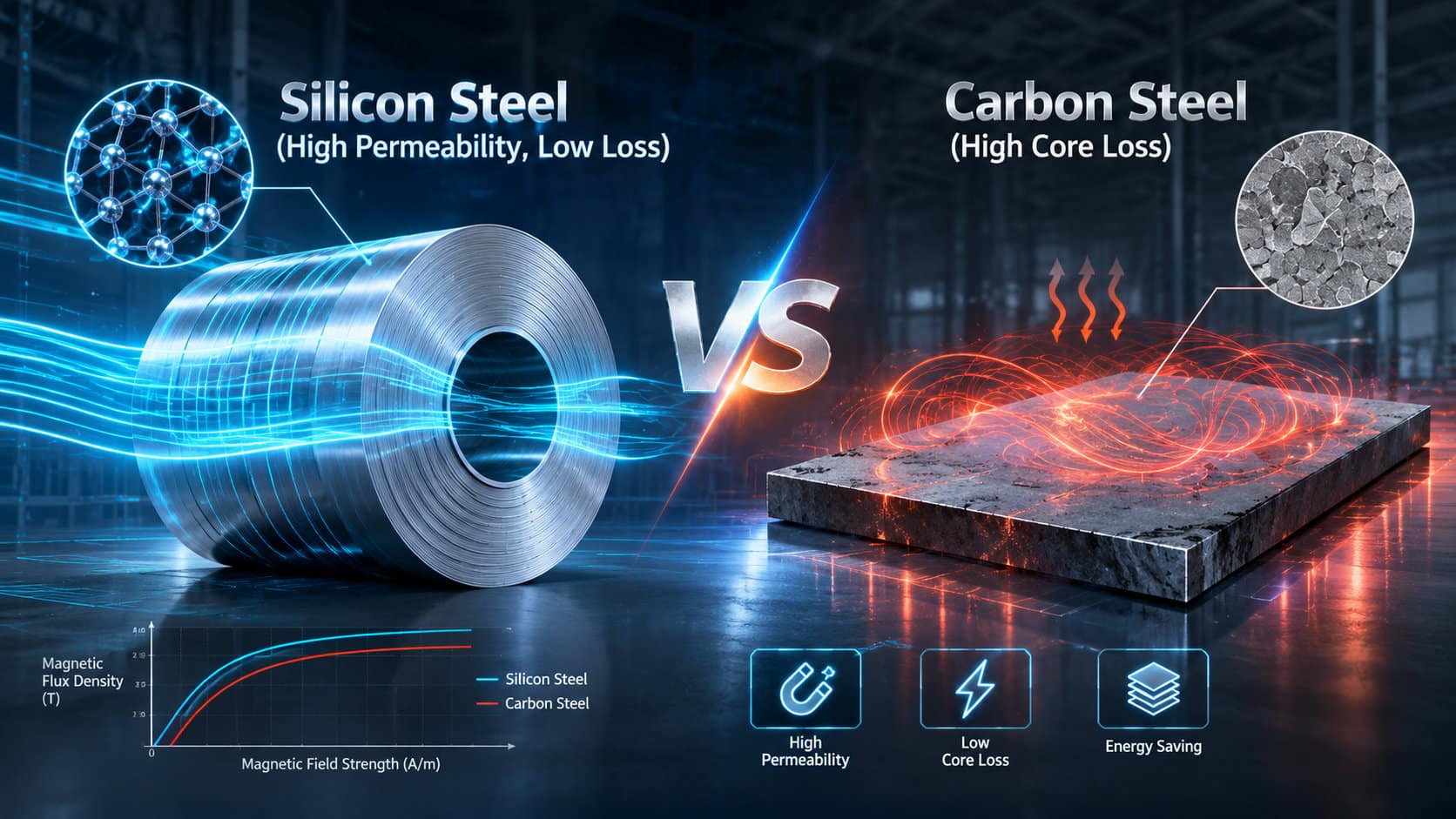
Electrical steel achieves up to 10 times higher magnetic permeability, 70% to 85% lower core loss, and significantly lower coercive force compared to commercial low-carbon mild steel.
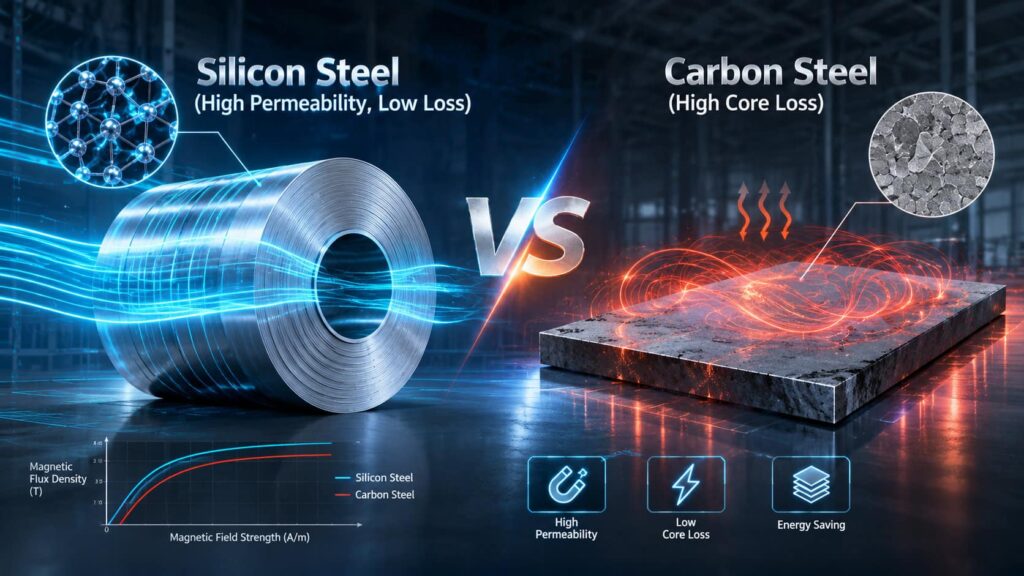
When exposed to alternating magnetic fields (50 Hz or 60 Hz), the magnetic performance gap between structural carbon steel (such as AISI 1008 or ASTM A36) and electrical steel becomes stark:
| Property / Parameter | Standard Low-Carbon Steel (e.g., AISI 1008) | Non-Oriented Electrical Steel (CRNGO) | Grain-Oriented Electrical Steel (CRGO) |
|---|---|---|---|
| Silicon Content (Si %) | < 0.10% (Trace) | 0.5% – 3.2% | 3.0% – 3.4% |
| Carbon Content (C %) | 0.08% – 0.13% | ≤ 0.005% (Decarburized) | ≤ 0.003% (Ultra-low) |
| Electrical Resistivity (µΩ·cm) | ~12 – 15 | ~30 – 52 | ~48 – 52 |
| Specific Core Loss at 1.5T/50Hz (W/kg) | 12.0 – 25.0+ W/kg (Severe heating) | 2.00 – 6.50 W/kg | 0.80 – 1.10 W/kg (at 1.7T) |
| Relative Magnetic Permeability (µr) | 500 – 1,500 | 3,000 – 8,000 | 15,000 – 45,000+ (Rolling axis) |
| Coercive Force Hc (A/m) | 100 – 250 A/m | 20 – 65 A/m | 8 – 15 A/m |
| Magnetic Aging Phenomenon | High (Core loss degrades over time) | Virtually Zero | Virtually Zero |
| Surface Insulation Coating | Uncoated / Mill Scale (Conductive) | Factory Inorganic/Organic Coating | High-temperature C-5 Glass film |
As demonstrated in the table, attempting to run alternating current through an unlaminated or uncoated carbon steel core results in massive classical eddy current loops, leading to rapid thermal runaway and insulation breakdown.
Mechanical Properties and Stampability: Strength vs Brittleness
While carbon steel offers superior ductility, weldability, and formability, electrical steel sacrifices mechanical elongation due to silicon-induced solid solution embrittlement.
The addition of silicon alters the mechanical behavior of the iron lattice:
- The Silicon Brittleness Ceiling: As silicon content approaches 3.5%, the room-temperature ductility of steel drops sharply. When silicon exceeds 4.0%, the alloy becomes excessively brittle and cannot be cold-rolled using conventional industrial rolling mills. For this reason, high-silicon grades (e.g., 3.2% Si) require strictly controlled punch-die clearances to prevent micro-cracking and jagged edge burrs during lamination stamping.
- Elongation and Tensile Strength: Standard mild carbon steel easily achieves 30% to 40% elongation before fracture, making it ideal for deep drawing, bending, and structural welding. In contrast, fully processed high-grade electrical steel exhibits elongation of only 15% to 25%, with increased hardness (HV10 160–220).
- Stamping Die Life: Punching millions of motor stator laminations from electrical steel accelerates cutting tool wear compared to soft low-carbon steel. Consequently, electrical steel is supplied with specialized lubricious semi-organic coatings (such as ASTM A976 C-4) designed to lubricate high-speed carbide punch tooling.
Can Carbon Steel Ever Replace Electrical Steel in Electromagnetic Devices?
Carbon steel can only replace electrical steel in purely direct current (DC) magnetic circuits or intermittent, non-critical actuators; it must never be used in continuous alternating current (AC) transformers or high-efficiency motors.
Understanding where carbon steel is acceptable versus where it is strictly prohibited avoids severe engineering failures:
Where Carbon Steel Is Permissible:
- DC Magnetic Relays and Solenoids: Under pure DC conditions, there is no alternating magnetic field ($f = 0\text{ Hz}$). Therefore, eddy current losses and hysteresis loops are non-existent during continuous energization. Heavy solid low-carbon steel bars or forgings work effectively as structural flux-carrying yokes.
- Heavy Lifting Electromagnets: Industrial crane scrap-handling magnets prioritize magnetic saturation flux density ($B_s$) and rugged structural strength over dynamic AC core loss. Solid cast carbon steel is the industry norm.
- Pole Shoes for Large Salient-Pole DC Generators: Thick low-carbon laminations can carry constant-polarity flux efficiently.
Where Electrical Steel Is Strictly Mandatory:
- Power and Distribution Transformers: Operating continuously at 50 Hz or 60 Hz, transformers require CRGO to limit no-load core losses. Using carbon steel would multiply standing losses by 1500%, instantly tripping thermal protection circuits and violating government efficiency regulations.
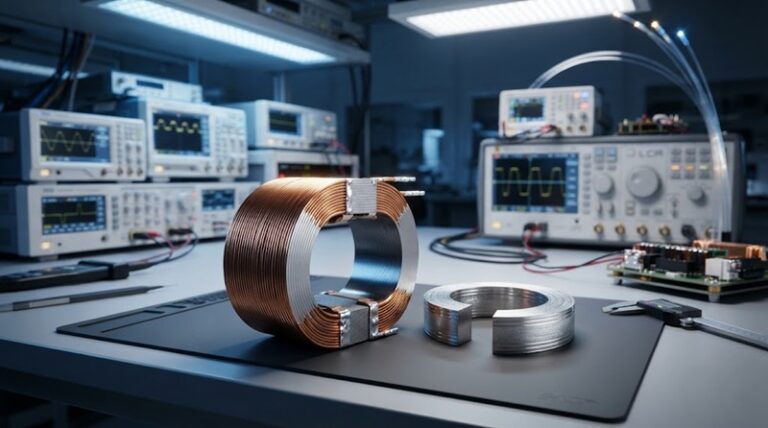
- AC Induction and EV Traction Motors: Electric vehicle motors operate at frequencies from 400 Hz to over 1500 Hz. Only thin-gauge CRNGO (0.20 mm to 0.35 mm) can dissipate the rapid flux reversals without burning out motor winding insulation.
Cost vs Efficiency: The Economic Equation in Core Material Selection
Although structural carbon steel costs 40% to 60% less per ton initially, the lifetime electricity cost of operational core losses makes electrical steel vastly more cost-effective within months of equipment operation.
When engineering electromagnetic equipment, purchasing decisions must be calculated through Total Cost of Ownership (TCO) rather than raw steel coil spot price:
In electric motors and distribution transformers, the purchase price of the core steel represents less than 5% of the total energy cost consumed by that device over a 20-year operational lifespan. Replacing a compliant electrical steel grade (e.g., MG50W470) with a cheaper low-silicon or carbon steel would incur severe energy penalties, exceeding the initial raw material savings within the first 500 operating hours.
Furthermore, international energy efficiency mandates—such as IEC 60034-30-1 (IE3 / IE4 motor standards) and U.S. DOE 2027 transformer efficiency rules—legally disqualify low-grade materials from grid and commercial connection.
Procurement Checklist: How to Specify and Order from Direct Mills
When sourcing from direct mills, procurement managers must submit exact silicon ranges, guaranteed iron loss at specific test frequencies, factory insulation coatings, and strict coil width tolerances.
To ensure you receive prime certified material tailored to your stamping or slitting line, include these criteria in your RFQ:
- Specify Functional Grade Rather Than Generic Names: Never request “silicon steel coil” without designated parameters. State the exact standard and loss code (e.g.,
EN 10106 M330-50AorASTM A677 47F190). - Require Surface Coating Classification: Specify whether your stamping process requires inorganic C-5 coating (heat and annealing resistant) or semi-organic C-4 coating (optimal punch-die lubricity).
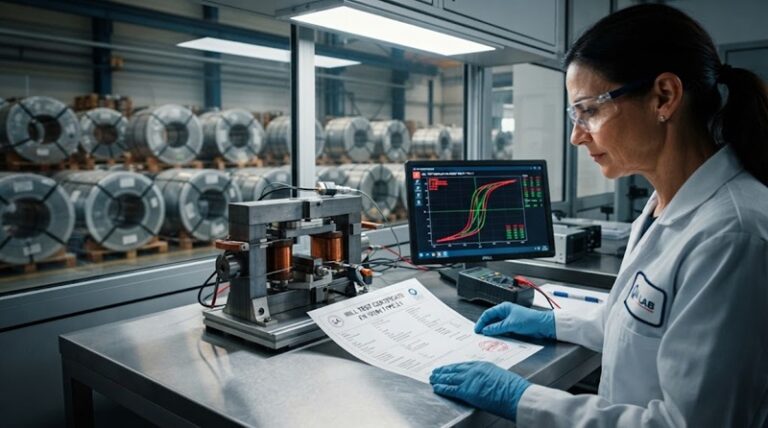
- Mandate Low Interstitial Element Limits: Verify on the EN 10204 3.1 Mill Test Certificate that Carbon is strictly ≤ 0.005% and Sulfur/Nitrogen are minimal to guarantee aging-free service.
- Audit Slit Width and Burr Tolerances: Request precision slitting tolerances within ±0.10 mm with guaranteed maximum edge burrs under 0.02 mm to prevent interlaminar short circuits during core stacking.
For custom slitting schedules, master coil mill allocations, and technical metallurgical consultations, get in touch with Megatop Group’s engineering specialists.
Frequently Asked Questions (FAQ)
Magnetic aging occurs when supersaturated interstitial carbon and nitrogen atoms slowly precipitate as fine iron carbides and nitrides inside the crystal lattice over time. These microscopic precipitates pin magnetic domain walls, causing a permanent 10% to 50% increase in core loss and a drastic drop in magnetic permeability.
While an iron alloy containing 6.5% silicon exhibits near-zero magnetostriction and minimal eddy loss, it is extremely brittle at room temperature and cannot be cold-rolled into coils using standard industrial strip mills. Specialized chemical vapor deposition (CVD) or rapid solidification methods are required, making 6.5% Si sheets niche and expensive.
Bare, uninsulated electrical steel rusts at a similar rate to carbon steel when exposed to humidity and condensation. However, electrical steel coils are delivered with factory-applied insulating coatings (such as C-4 or C-5) and packaged in heavy-duty VCI anti-rust barrier wrapping to ensure ocean freight protection.
References and Authoritative Standards
- ASM International: ASM Handbook, Volume 2: Properties and Selection: Nonferrous Alloys and Special-Purpose Materials (Soft Magnetic Materials Section). Materials Park, OH. https://www.asminternational.org/
- ASTM A677 / A677M: Standard Specification for Nonoriented Electrical Steel Fully Processed Types. ASTM International. https://www.astm.org/a0677_a0677m-16.html
- IEC 60404-1: Magnetic materials – Classification of magnetic materials into groups and specific alloy families. International Electrotechnical Commission. https://webstore.iec.ch/publication/2026
- IEEE Magnetics Society: Transactions on Magnetics: Hysteresis Loss Mechanisms and Silicon Influence in Electrical Steel. IEEE Xplore. https://ieeexplore.ieee.org/
- World Steel Association: Electrical Steels: Powering the Clean Energy Transition. Worldsteel Committee on Technology. https://worldsteel.org/