Electrical steel procurement requires deciphering complex alphanumeric grade codes. Specifically, engineers and purchasing agents encounter designations like 35H230, B35A250, and M250-35A. At first glance, these industry codes appear bewildering and inconsistent. However, every designation follows systematic metallurgical naming principles. Understanding these codes enables buyers to identify equivalent materials across competing mills. Consequently, companies avoid costly procurement delays and prevent material mismatches. This comprehensive guide explains how major international standards and global mills structure their electrical steel grades.
What Do the Numbers and Letters in Electrical Steel Grades Actually Mean?
Electrical steel grade designations encode three vital engineering parameters: nominal thickness, material classification, and maximum guaranteed core loss. Specifically, the leading digits indicate strip thickness in hundredths of a millimeter. Meanwhile, letter codes distinguish grain-oriented from non-oriented alloys, and trailing numbers specify maximum iron loss.
Almost all international naming systems follow a standardized three-part structural syntax. Although specific prefixes change across manufacturers, the fundamental formula remains consistent.
In practice, you can break down almost any electrical steel grade into three core segments:
- Part 1: Nominal Thickness: The first two or three digits represent nominal strip thickness multiplied by one hundred. For example, ’35’ denotes 0.35 mm steel, ’50’ denotes 0.50 mm steel, and ’23’ indicates 0.23 mm sheet.
- Part 2: Material Class & Processing Type: The central letters indicate crystalline orientation and product tier. For instance, ‘A’ or ‘W’ represents standard non-oriented steel. Conversely, ‘Q’, ‘G’, or ‘R’ designates grain-oriented transformer steel.
- Part 3: Guaranteed Core Loss: The trailing numerical value specifies maximum allowable core loss multiplied by one hundred or ten. In metric standards, this loss is rated in Watts per kilogram (W/kg).
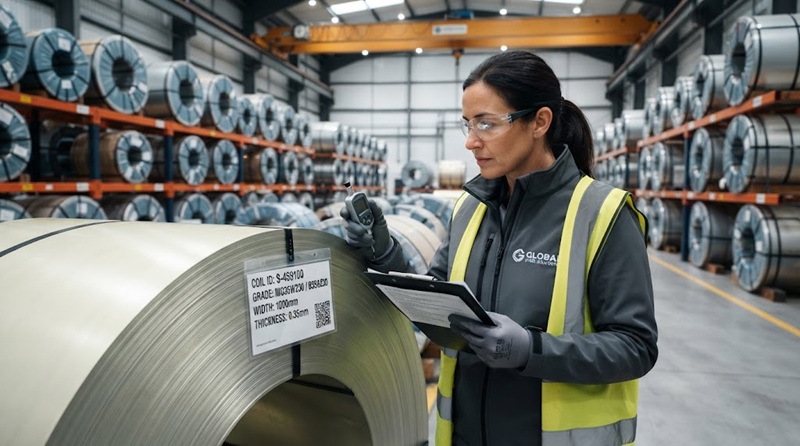
Consider the common grade 35A250 as a concrete example. The ’35’ indicates a nominal thickness of 0.35 mm. Next, ‘A’ designates non-grain-oriented electrical steel. Finally, ‘250’ guarantees that maximum core loss will not exceed 2.50 W/kg at 1.5 Tesla and 50 Hz.
Decoding Major Mill Naming Systems: Baosteel, Nippon Steel, POSCO, and Megatop
Major global steel mills use proprietary prefixes and suffixes while adhering to standard metallurgical logic. Specifically, Baosteel uses the ‘B’ prefix, Nippon Steel uses ‘H’ or ‘T’, and POSCO utilizes ‘PN’. Understanding these mill-specific formats enables procurement teams to identify equivalent grades rapidly across global suppliers.
While international standards establish baseline guidelines, individual steel mills brand their products uniquely. Below is an engineering breakdown of major global mill conventions:
1. Baosteel (China) Naming Conventions
Baosteel prefixes all grades with the letter ‘B’. For standard CRNGO electrical steel, they follow the format B + Thickness + Class + Loss. For example, in B35A250, ‘B’ represents Baosteel, ’35’ denotes 0.35 mm thickness, ‘A’ signifies non-oriented steel, and ‘250’ indicates 2.50 W/kg maximum loss. For electric vehicle high-frequency grades, Baosteel adds ‘AHV’ or ‘AP’ to indicate specialized high-permeability processing.
For CRGO electrical steel, Baosteel utilizes ‘R’ for conventional grain-oriented steel (e.g., B23R085). Furthermore, they use ‘P’ for high-permeability Hi-B steel (e.g., B23P080), and ‘R-DR’ for laser domain-refined products.
2. Nippon Steel Corporation (Japan) Conventions
Nippon Steel omits corporate prefixes, starting directly with strip thickness. For non-oriented grades, they use ‘A’ for standard commercial grades (e.g., 50A290). In addition, they employ ‘H’ to designate high-efficiency, low-loss grades engineered for industrial motors (e.g., 35H230). In their oriented portfolio, ‘G’ denotes standard CRGO, while ‘ZH’ designates high-permeability laser domain-refined steel (e.g., 23ZH085).
3. POSCO (South Korea) Conventions
POSCO incorporates ‘PN’ into non-oriented grades to signify POSCO Non-Oriented steel (e.g., 35PN230). In their oriented line, ‘PG’ denotes POSCO Grain-Oriented steel, while ‘PH’ identifies high-permeability Hi-B steel (e.g., 23PH085).
4. Megatop Group International Designation
Megatop Group utilizes a transparent, standardized designation system tailored for international trade. Non-oriented grades use the format MG + Thickness + W + Loss (e.g., MG35W230). Here, ‘MG’ stands for Megatop Group, ’35’ represents 0.35 mm, ‘W’ signifies non-oriented silicon steel, and ‘230’ guarantees 2.30 W/kg maximum loss at 1.5 T / 50 Hz. Oriented transformer grades feature ‘Q’ for Hi-B (e.g., MG23Q085) and ‘Q-DR’ for domain-refined materials.
Cross-Reference Table: CRNGO and CRGO Grade Equivalents Across Global Mills
Cross-referencing electrical steel requires comparing guaranteed maximum core loss at identical excitation levels. While mill brand names differ, their magnetic loss limits and saturation values correspond closely across international equivalents. The table below provides a verified cross-reference guide across major global mills.
| Category | Nominal Gauge | Megatop Grade | Baosteel Equivalent | Nippon Steel Equivalent | POSCO Equivalent | European EN 10106/107 | Max Core Loss |
|---|---|---|---|---|---|---|---|
| Thin-Gauge CRNGO | 0.25 mm | MG25W1300 | B25AHV1300 | 25H1300 | 25PN1300 | M130-25A | ≤ 13.0 W/kg (1.0T/400Hz) |
| Thin-Gauge CRNGO | 0.27 mm | MG27W1400 | B27AHV1400 | 27H1400 | 27PN1400 | M140-27A | ≤ 14.0 W/kg (1.0T/400Hz) |
| IE4 Industrial CRNGO | 0.35 mm | MG35W230 | B35A230 | 35H230 | 35PN230 | M230-35A | ≤ 2.30 W/kg (1.5T/50Hz) |
| IE3 Industrial CRNGO | 0.50 mm | MG50W290 | B50A290 | 50A290 | 50PN290 | M290-50A | ≤ 2.90 W/kg (1.5T/50Hz) |
| Standard Hi-B CRGO | 0.27 mm | MG27Q095 | B27P095 | 27ZH095 | 27PH095 | M095-27P | ≤ 0.95 W/kg (1.7T/50Hz) |
| Laser Refined CRGO | 0.23 mm | MG23Q080-DR | B23R080-DR | 23ZH080 | 23PH080-DR | M080-23P | ≤ 0.80 W/kg (1.7T/50Hz) |
Table 1: International electrical steel grade cross-reference matrix comparing Megatop, Baosteel, Nippon Steel, POSCO, and European standards.
Review our complete specifications for electrical steel products and grades to match your exact production drawings.
How Do International Standards (IEC, EN, JIS, ASTM) Differ in Coding?
International standards differ primarily in testing frequency, magnetic flux density thresholds, and measurement units. Specifically, European EN and international IEC standards use the letter ‘M’ followed by core loss and thickness. In contrast, American ASTM standards designate grades by maximum loss in watts per pound at sixty hertz.
Procurement teams must recognize how regional standards structure their official specifications:
- European Standard (EN 10106 / EN 10107): Formatted as M + Core Loss + Thickness + Type. For example, in M250-35A, ‘M’ stands for magnetic material. Next, ‘250’ represents 2.50 W/kg maximum loss at 1.5 T / 50 Hz. Then, ’35’ indicates 0.35 mm thickness, and ‘A’ specifies non-oriented steel. In oriented steel, ‘P’ denotes high permeability (e.g., M085-23P).
- Japanese Industrial Standard (JIS C 2552 / C 2553): Formatted as Thickness + Class + Loss. For example, 35A250 signifies 0.35 mm non-oriented steel with 2.50 W/kg maximum loss. For grain-oriented steel, JIS uses ‘G’ for regular grades and ‘P’ for Hi-B.
- American ASTM Standard (ASTM A677 / A876): ASTM uses an entirely different imperial coding system. For example, in grade 36F145, ’36’ indicates nominal thickness in hundredths of a mil (approx. 0.36 mm). The letter ‘F’ designates fully processed non-oriented material. Finally, ‘145’ denotes a maximum core loss of 1.45 Watts per pound (W/lb) tested at 15 kilogauss (1.5 Tesla) and 60 Hz.
Consequently, buyers must never confuse metric W/kg at 50 Hz with imperial W/lb at 60 Hz. Multiplying W/lb by 2.2046 converts mass to kilograms, but frequency differences (50 Hz vs 60 Hz) require separate magnetic recalculation.
Procurement Checklist: Five Critical Items on a Mill Test Certificate (MTC)
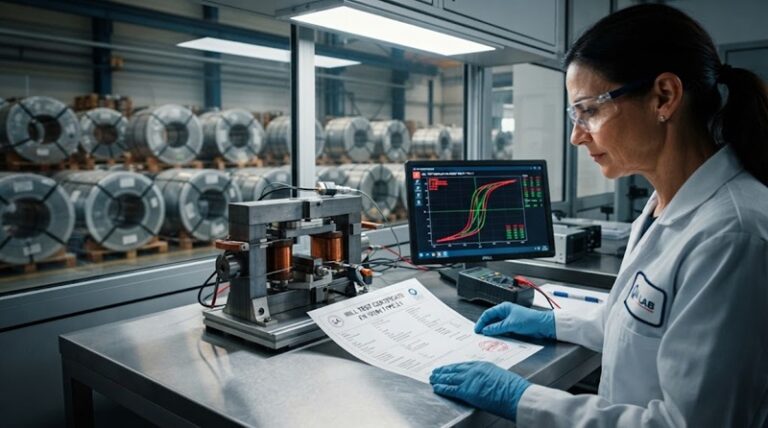
Reviewing a Mill Test Certificate requires verifying core loss guarantees, test frequency, coating class, and mechanical tolerances. Specifically, procurement officers must confirm whether iron loss was tested at 50 Hz or 60 Hz. Furthermore, checking slitting burr heights and transverse thickness crown ensures seamless stamping without core distortion.
When inspecting an incoming Mill Test Certificate (MTC), verify these five critical engineering data points:
- Testing Method and Direction: Check whether tests followed the Epstein frame method (IEC 60404-2) or Single Sheet Tester (SST per IEC 60404-3). SST values typically report 5% to 10% higher losses than Epstein tests. For non-oriented coils, verify that samples were tested half longitudinally and half transversely.
- Magnetic Polarization Guarantees: Confirm minimum magnetic polarization at specified field strengths. Ensure non-oriented motor steel achieves B50 ≥ 1.68–1.72 Tesla to protect motor torque density.
- Coating Type and Insulation Resistance: Verify the applied surface insulation coating code (such as AISI C-5 or EC-5-P). Confirm that surface insulation resistance exceeds 50 Ω·cm2 per lamination.
- Transverse Thickness Profile (Crown): Inspect coil center-to-edge thickness variation. High-speed progressive stamping dies require transverse crown values below 3 to 5 μm to prevent core fanning.
- Mechanical Strength for Rotors: For high-speed motor rotors, verify mechanical yield strength (σ0.2) and elongation. Rotor steels must withstand intense centrifugal stress without plastic deformation.
Discover how Megatop Group maintains strict quality verification across every shipped master coil and slit pack.
Frequently Asked Questions (FAQ) About Electrical Steel Grades
What is the practical difference between fully processed and semi-processed electrical steel?
Fully processed electrical steel has undergone final continuous decarburization and recrystallization annealing at the steel mill. Consequently, customers can stamp laminations and assemble motor cores directly without further heat treatment. In contrast, semi-processed steel requires final stress-relief annealing by the customer to develop its final magnetic properties and burn off residual carbon.
Can I substitute a 50 Hz rated grade directly into a 60 Hz motor design?
Yes, but you must recalculate total core losses using Steinmetz or Bertotti loss separation formulas. Operating a 50 Hz rated steel at 60 Hz increases core loss by approximately 25% to 30%. Therefore, motor designers must verify that cooling systems can handle this higher thermal dissipation without exceeding motor temperature class limits.
What do the suffixes ‘DR’, ‘H’, and ‘AP’ signify on modern steel datasheets?
These suffixes indicate premium metallurgical treatments. Specifically, ‘DR’ stands for Domain Refined grain-oriented steel treated with lasers to minimize eddy currents. In non-oriented steels, ‘H’ signifies high-efficiency grades with reduced core losses. Meanwhile, ‘AP’ or ‘AHV’ denotes automotive-grade thin-gauge steel engineered with high permeability for electric vehicle traction motors.
Authoritative Technical References & Standards
- International Electrotechnical Commission (IEC): IEC 60404-1: Magnetic materials – Classification and Specification Standards.
- European Committee for Iron and Steel Standardization (ECISS): EN 10106: Cold rolled non-oriented electrical steel sheet and strip delivered in the fully processed state.
- Japanese Standards Association (JSA): JIS C 2552: Cold-rolled non-grain-oriented electrical steel strip and sheet specifications.
- ASTM International: ASTM A677: Standard Specification for Non-Grain-Oriented Electrical Steel Fully Processed Types.
- Chinese National Standardization Administration: GB/T 2521.1: Cold-rolled electrical steel delivery conditions – Non-oriented and oriented sheets.
- Worldsteel Association: Global Nomenclature and Standardization Trends for Electrical Steel Products.
Need assistance matching drawing grades or sourcing hard-to-find international equivalents? Contact Megatop Group’s metallurgical specialists today for expert grade cross-referencing and competitive mill-direct quotations.