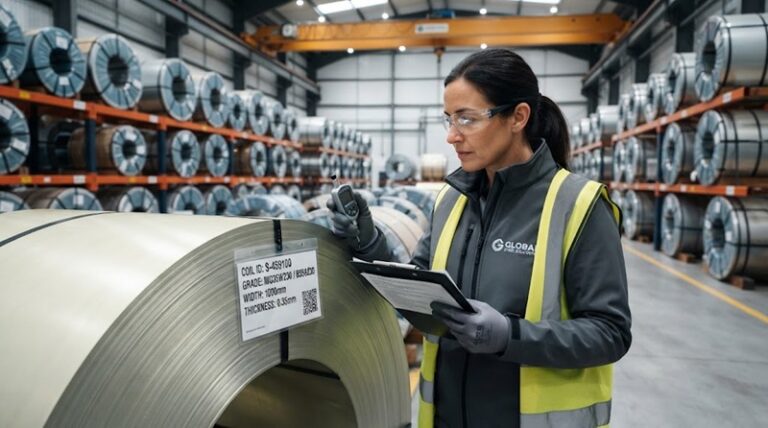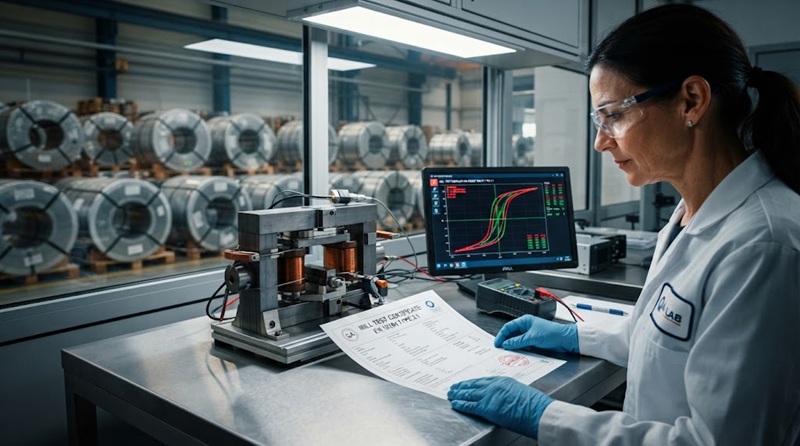
Receiving an electrical steel shipment requires thorough documentation review. Specifically, the Mill Test Certificate serves as the definitive legal and technical record. This document certifies that delivered coils meet contractual magnetic and dimensional specifications. However, many procurement officers only check nominal thickness and total coil weight. Consequently, critical magnetic and mechanical non-conformances often go unnoticed until factory stamping begins. Such oversights can trigger severe motor overheating or transformer core failure. This guide explains how to audit an electrical steel certificate systematically.
What Is an Electrical Steel Mill Test Certificate (EN 10204 3.1)?
An electrical steel Mill Test Certificate is an official quality document issued by an accredited mill inspection department. Specifically, EN 10204 Type 3.1 certification validates that specific production coils satisfy guaranteed magnetic, dimensional, and mechanical properties. Consequently, it serves as mandatory verification before steel enters automotive stamping or transformer core assembly.
International steel procurement relies on the European EN 10204 standard for metallic product documentation. In general, certificates fall into two distinct administrative categories:
- EN 10204 Type 2.2: A non-specific test report based on general factory quality testing. It does not certify data from the buyer’s specific production lot.
- EN 10204 Type 3.1: A specific inspection certificate validated by an independent factory inspection representative. It contains actual test values recorded directly from the specific master coils delivered.
For high-performance motor laminations and transformer cores, buyers must always mandate Type 3.1 documentation. Furthermore, this document establishes legal material traceability from melt shop to final slitting. Specifically, every certificate references a unique heat number, cast sequence, and mother coil identifier.
Under IATF 16949 automotive standards, this documentation must remain archived throughout product vehicle lifecycles. Therefore, conducting an immediate, thorough audit protects downstream manufacturing operations.
How to Audit Magnetic Property Values: Core Loss and Polarization
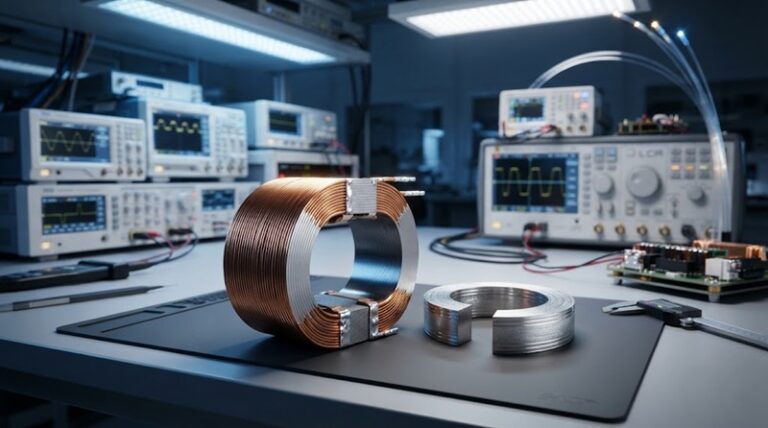
Auditing magnetic properties requires verifying iron loss guarantees and magnetic polarization under precise test conditions. Specifically, inspectors must check whether core losses were measured at fifty hertz or sixty hertz. Furthermore, confirming test methodology—whether Epstein frame or Single Sheet Tester—prevents unexpected magnetic efficiency discrepancies in finished components.
Magnetic performance represents the most critical section on any electrical steel test report. When auditing these values, verify three distinct parameters:
1. Specific Total Core Loss Guarantees
For CRNGO electrical steel, the primary benchmark is specific core loss at 1.5 Tesla and 50 Hz (P1.5/50). For electric vehicle traction grades, verify high-frequency losses at 400 Hz (P1.0/400). For CRGO electrical steel, check guaranteed loss at 1.7 Tesla (P1.7/50).
Always verify the test frequency listed on the document. Running a 50 Hz rated coil on a 60 Hz grid increases core loss by approximately 25% to 30%. Consequently, operating assumptions must align with local grid standards.
2. Magnetic Polarization Thresholds
Magnetic polarization reflects the material’s magnetic permeability and saturation behavior. For non-oriented motor steel, check polarization at 5,000 A/m (B50). Standard industrial grades require B50 ≥ 1.68 to 1.72 Tesla. If B50 falls below this threshold, the motor will draw excess magnetizing current, increasing copper winding losses.
In contrast, grain-oriented transformer steel is evaluated at 800 A/m (B8). Premium Hi-B grades require B8 ≥ 1.90 to 1.93 Tesla to prevent transformer core saturation.
3. Testing Apparatus: Epstein Frame vs. Single Sheet Tester (SST)
The certificate must state the test apparatus clearly. The 25 cm Epstein frame method (IEC 60404-2) remains the standard referee method. In contrast, the Single Sheet Tester (IEC 60404-3) tests uncut strip sheets directly.
In practice, SST testing typically reports 5% to 10% higher core loss values than Epstein testing. Therefore, engineers must account for this difference when auditing compliance against standard catalogue limits.
Comprehensive MTC Inspection Checklist: Key Parameters & Tolerances
Auditing an electrical steel certificate requires evaluating mechanical strength, dimensional tolerances, and surface insulation alongside magnetic data. Neglecting mechanical yield strength or thickness crown can cause high-speed stamping die jams and core waviness. The table below outlines mandatory inspection thresholds for incoming shipments.
| Inspection Category | Specific Test Parameter | Standard Target / Threshold | Testing Standard | Engineering Risk if Non-Compliant |
|---|---|---|---|---|
| Magnetic Loss | P1.5/50 (CRNGO) / P1.7/50 (CRGO) | Must not exceed grade limit | IEC 60404-2 (Epstein) | Motor or transformer thermal overheating |
| Permeability | B50 (CRNGO) / B8 (CRGO) | B50 ≥ 1.68T / B8 ≥ 1.90T | IEC 60404-2 | Elevated reactive magnetizing current draw |
| Thickness Crown | Center-to-edge profile difference | ≤ 3 μm (thin) / ≤ 5 μm (std) | EN 10106 / JIS C 2552 | Assembled lamination core fanning & bowing |
| Slit-Edge Burr | Maximum mechanical burr height | ≤ 3 μm to 5 μm | Automotive QA Spec | Insulation coating puncture & eddy shorts |
| Surface Insulation | Franklin surface resistance test | ≥ 50 Ω·cm2 per lamination | ASTM A717 / IEC 60404-11 | Interlaminar circulating eddy current faults |
| Yield Strength | Proof strength Rp0.2 (σ0.2) | ≥ 450–600 MPa (EV Rotors) | ISO 6892-1 / ASTM E8 | Centrifugal rotor bridge structural rupture |
| Chemical Aging | Residual Carbon content (C) | ≤ 0.003% (≤ 30 ppm) | Optical Emission Spec | Magnetic aging and progressive loss increases |
Table 1: Technical audit criteria and non-conformance risks for electrical steel Mill Test Certificates.
Review our complete specifications for electrical steel products and grades to compare mill delivery standards.
Verifying Dimensional Tolerances: Crown, Flatness, and Burr Limits
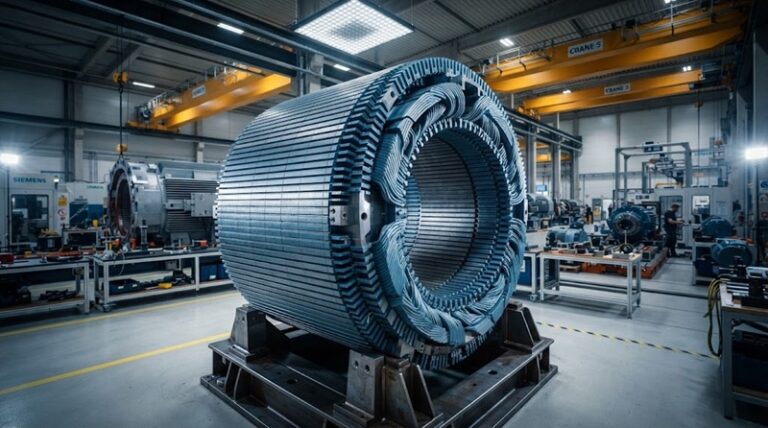
Dimensional precision is just as critical as magnetic performance for high-speed automated stamping lines. Specifically, excessive transverse thickness variation (crown) causes core fanning and height distortion during lamination stacking. Furthermore, elevated slitting burrs puncture surface insulation coatings, triggering circulating interlaminar eddy currents and premature core failure.
During incoming inspection audits, quality teams must examine strip geometry closely:
- Transverse Thickness Profile (Crown): Coils naturally exhibit slightly greater thickness at the center than at edges. For precision 0.20 mm to 0.27 mm thin-gauge strips, this crown must remain strictly below 3 μm. In a finished stator core containing hundreds of laminations, uneven crown causes loose stamping stacks.
- Strip Flatness and Wave Height: The certificate should document coil flatness tolerances. Wave height ratios must stay below 1.0% to 1.5%. Wavy strips vibrate inside progressive stamping dies, leading to tool jamming and premature carbide punch chipping.
- Slit-Edge Burr Control: Burr heights must be audited after master coil slitting. Maximum burrs must never exceed 5 μm. During core clamping, sharp burrs penetrate inorganic surface coatings, creating inter-laminar conductive paths across adjacent sheets.
Auditing Surface Coatings and Mechanical Properties for Motor Rotors
Auditing surface coatings and mechanical properties prevents electrical breakdowns and mechanical rotor failures under centrifugal loads. Specifically, Franklin insulation testing must confirm surface resistance exceeding fifty ohm-centimeters squared per lamination. Moreover, high-speed motor rotors require minimum mechanical yield strength validation exceeding 450 to 550 megapascals.
Surface coating integrity prevents electrical breakdown across the assembled core stack. Most industrial certificates specify coatings complying with AISI C-4, C-5, or self-bonding varnish classes. Inspectors must verify surface insulation resistance via the Franklin test method (ASTM A717).
A compliant coating delivers surface insulation resistance exceeding 50 Ω·cm2 per lamination. For direct oil-cooled electric vehicle drive units, the certificate must also guarantee chemical resistance against synthetic automatic transmission fluids (ATF).
Furthermore, mechanical properties demand rigorous verification for rotating electrical machines:
- Yield Strength (Rp0.2): High-speed EV motors subject narrow rotor bridges to extreme centrifugal loads. Therefore, rotor steels must demonstrate minimum yield strength between 450 MPa and 600 MPa.
- Tensile Elongation (A50): Adequate elongation (typically > 12% to 18%) ensures clean punchability without brittle edge fracturing during high-speed die stamping.
- Carbon Content and Aging Resistance: Residual carbon must not exceed 0.003% (30 ppm). Excessive carbon precipitates into fine iron carbides over operating years, causing magnetic aging and rising core losses.
Discover how Megatop Group enforces rigorous quality audits across all slit coils and export packaging.
Frequently Asked Questions (FAQ) About Electrical Steel MTC Audits
What should I do if our incoming laboratory test contradicts the mill certificate?
First, verify that your test methodology matches the certificate standard precisely. Confirm whether the mill tested via Epstein frame or Single Sheet Tester. Second, verify sample cutting directions. Non-oriented steels require testing mixed longitudinal and transverse samples. In contrast, grain-oriented steel must be tested strictly parallel to the rolling direction. If discrepancies persist beyond standardized testing tolerances, initiate a formal joint re-test with the mill representative.
Why do electrical steel certificates record minimal chemical elements compared to alloy steels?
Electrical steel performance is governed primarily by magnetic and physical parameters rather than complex chemistry. Therefore, certificates typically report only critical functional elements: Silicon (Si), Aluminum (Al), Manganese (Mn), and residual Carbon (C). Silicon and aluminum increase electrical resistivity, while carbon must remain minimal to prevent magnetic aging. Other trace elements are held strictly below impurity limits.
What is magnetic aging, and how does the certificate guarantee aging resistance?
Magnetic aging occurs when dissolved interstitial carbon or nitrogen atoms precipitate over time under operational motor temperatures. These microscopic precipitates pin magnetic domain walls, increasing hysteresis losses progressively. Compliant mills enforce continuous vacuum decarburization to lower carbon below 0.003%. The certificate guarantees aging resistance by confirming ultra-low carbon or by reporting accelerated thermal aging test results per IEC 60404-2.
Authoritative Technical References & Standards
- European Committee for Standardization (CEN): EN 10204: Metallic products – Types of inspection documents.
- International Electrotechnical Commission (IEC): IEC 60404-2: Methods of measurement of magnetic properties of electrical steel by means of an Epstein frame.
- International Organization for Standardization (ISO): ISO 6892-1: Metallic materials – Tensile testing at ambient temperature.
- ASTM International: ASTM A717 / A717M: Standard Test Method for Surface Insulation Resistivity of Single-Strip Specimens.
- International Electrotechnical Commission (IEC): IEC 60404-11: Methods of test for the determination of surface insulation resistance of electrical steel.
- Worldsteel Association: Quality Assurance Protocols and Inspection Guidelines for Electrical Steels.
Need verified mill test certificates or sample testing reports for upcoming projects? Contact Megatop Group’s technical team today to review certified test documentation and discuss your grade requirements.