Silicon steel—widely known as electrical steel—serves as the magnetic core backbone for modern electrical power grids, renewable energy systems, and electric transportation. When specifying materials for electromagnetic equipment, engineers and procurement managers primarily choose between two distinct metallurgical families: Cold Rolled Grain Oriented (CRGO) steel and Cold Rolled Non-Oriented (CRNGO) steel.
While both alloys share an iron-silicon matrix engineered to minimize energy loss, their microscopic crystal structures, directional magnetic behaviors, and manufacturing methods differ substantially. Selecting the incorrect grade can lead to severe operational overheating, unacceptable energy losses, or premature equipment failure.
Below is an engineering guide to understanding the metallurgical distinctions, magnetic performance trade-offs, and application criteria between CRGO and CRNGO, supported by direct mill data from Megatop Group’s electrical steel solutions.
What Is the Core Difference Between CRGO and CRNGO Electrical Steel?
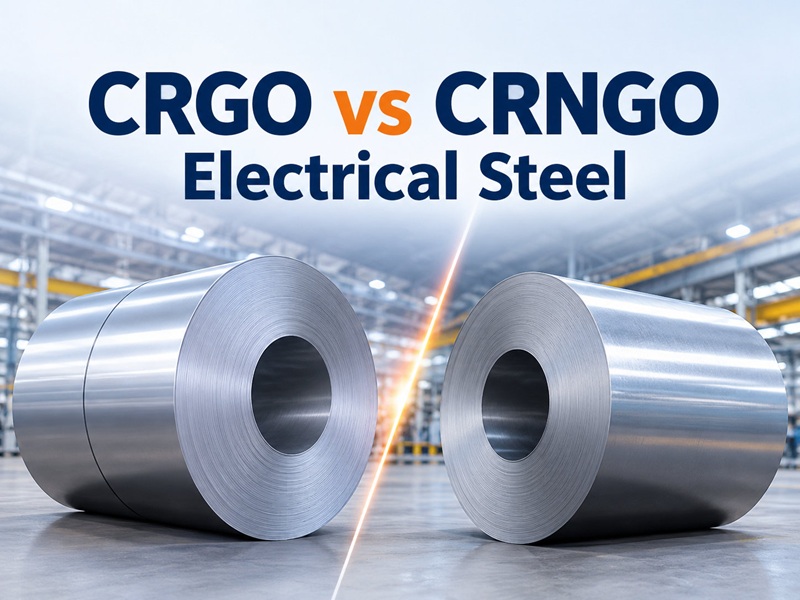
The fundamental difference is that CRGO electrical steel features an anisotropic crystal structure optimized for unidirectional magnetic flux in static equipment, whereas CRNGO features an isotropic structure providing uniform magnetic permeability in all directions for rotating machinery.
At a metallurgical level, electrical steel is an iron alloy containing silicon (typically 0.5% to 3.5% Si). Silicon increases electrical resistivity, which dramatically suppresses eddy current losses when exposed to alternating magnetic fields. However, how those iron-silicon crystals are aligned during cold rolling dictates the material’s magnetic classification.
- Cold Rolled Grain Oriented Electrical Steel (CRGO): Undergoes complex secondary recrystallization processing to orient virtually all crystal grains in the rolling direction (Goss texture {110}<001>). This alignment yields exceptionally high magnetic permeability and ultra-low core loss along the longitudinal axis, but poorer magnetic performance across the transverse axis.
- Cold Rolled Non-Oriented Electrical Steel (CRNGO): Processed without directional secondary recrystallization, producing a randomly distributed, isotropic planar grain structure. As a result, CRNGO delivers uniform magnetic properties and consistent core loss regardless of the magnetic field’s direction relative to the rolling strip.
| Technical Parameter | Cold Rolled Grain Oriented (CRGO) | Cold Rolled Non-Oriented (CRNGO) |
|---|---|---|
| Crystal Texture | Highly oriented Goss texture {110}<001> | Randomly oriented, isotropic grain matrix |
| Magnetic Property | Strongly Anisotropic (directional along rolling axis) | Isotropic (uniform across all planar directions) |
| Typical Silicon Content | 3.0% – 3.4% Si | 0.5% – 3.2% Si (varies widely by grade) |
| Standard Thicknesses | 0.23 mm, 0.27 mm, 0.30 mm, 0.35 mm | 0.20 mm, 0.35 mm, 0.50 mm, 0.65 mm |
| Magnetic Flux Density (B50 / B800) | Very high (≥ 1.82 T up to 1.95 T in Hi-B grades) | Moderate (1.60 T – 1.75 T) |
| Specific Core Loss (P1.5/50 or P1.7/50) | Ultra-low (0.75 – 1.20 W/kg at 1.7 T, 50 Hz) | Moderate (2.0 – 6.5 W/kg at 1.5 T, 50 Hz) |
| Mechanical Workability | Highly brittle; sensitive to punching stress | Better ductility; ideal for high-speed stamping |
| Primary End Use | Power & distribution transformers, reactors, CTs | Electric motors, generators, EV traction drives |
| Relative Production Cost | Higher (requires multi-stage annealing & laser scribing) | Moderate to economical |
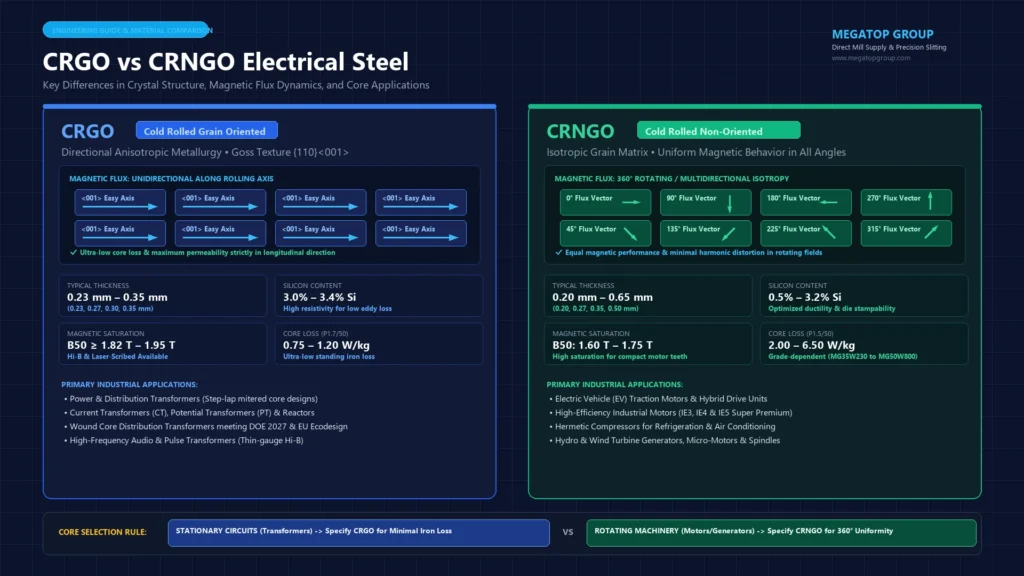
Crystal Structure and Goss Texture: How Orientation Dictates Magnetic Behavior
CRGO steel achieves its superior magnetic conductivity through the Goss texture alignment, where the easiest magnetization crystallographic axis <001> is parallel to the strip’s rolling direction.
Body-centered cubic (BCC) iron crystals possess distinct directions of easy magnetization. The <100> cube edge requires the least magnetizing force to achieve magnetic saturation, whereas the <111> body diagonal requires the highest energy.
During the manufacturing of grain-oriented silicon steel, high-temperature slab heating, continuous hot rolling, controlled cold rolling passes, and decarburization annealing are followed by a prolonged high-temperature secondary recrystallization stage (often exceeding 1150°C in a dry hydrogen atmosphere). Inhibitors such as manganese sulfide (MnS) or aluminum nitride (AlN) restrain regular grain growth, allowing only grains with the Goss orientation ({110}<001>) to consume competing grains. This orientation aligns the “easy axis” straight along the strip length.
Conversely, non-oriented electrical steel avoids directional secondary grain growth. The strip undergoes controlled hot and cold rolling with final continuous annealing at lower temperatures, producing a homogeneous, fine-grained structure where magnetic domains can rotate freely with minimal angular resistance.
Magnetic Performance Compared: Core Loss, Permeability, and Saturation
Under standard alternating magnetic fields, CRGO delivers 40% to 60% lower specific core losses and significantly higher operating permeability than CRNGO when magnetized in the rolling direction.
Total core loss (iron loss) consists of three physical components:
- Hysteresis loss (Ph): The energy required to reverse magnetic domains during each AC cycle.
- Classical eddy current loss (Pe): Induced circulating currents within the steel sheets, proportional to (thickness)² / resistivity.
- Anomalous (excess) loss (Pa): Microscopic energy dissipation during magnetic domain wall displacement.
Permeability and Operating Flux Density
Because CRGO aligns nearly 95% of its crystallographic grains along the magnetic circuit path, it achieves magnetic saturation with minimal magnetizing current. Modern conventional grain-oriented (CGO) grades achieve 1.82 T to 1.87 T at 800 A/m, while high-permeability (Hi-B) and laser-scribed grades exceed 1.92 T. This enables transformer designers to operate at higher flux densities without driving the core into thermal runaway or saturation.
CRNGO, having random grain orientations, requires higher magnetizing fields (H) to overcome hard magnetization axes (<111>). Consequently, its saturation flux density typically caps around 1.65 T – 1.72 T.
Core Loss Characteristics
At standard industrial frequencies (50 Hz or 60 Hz):
- A top-tier 0.23 mm Hi-B CRGO lamination exhibits core losses below 0.80 W/kg at 1.7 Tesla.
- A premium 0.35 mm high-grade CRNGO lamination exhibits core losses around 2.10 – 2.40 W/kg at 1.5 Tesla, rising substantially above 1.5 T.
However, at high operating frequencies (such as 400 Hz to 2000 Hz in modern high-speed electric vehicle traction motors), eddy current losses dominate. Thin-gauge CRNGO (0.20 mm to 0.30 mm) specifically engineered with elevated silicon-aluminum contents is preferred because it maintains isotropic balance while suppressing high-frequency heat buildup.
Why Is CRGO Used in Transformers While CRNGO Is Used in Motors?
CRGO is engineered for stationary transformers where magnetic flux flows along a predetermined linear path, whereas CRNGO is required for rotating motors where the magnetic vector continuously rotates 360 degrees through stators and rotors.
Why Transformers Rely on CRGO
In power transformers, distribution transformers, and current transformers, the magnetic core consists of stationary legs and yokes. The magnetic flux travels in fixed, predictable loops. By fabricating the core with step-lap mitered joints or wound core geometries aligned strictly with the rolling direction, transformer manufacturers capitalize fully on CRGO’s low hysteresis and high permeability. This directly reduces no-load losses (standing losses), ensuring compliance with international efficiency mandates such as the U.S. Department of Energy (DOE 2027) standards and EU Ecodesign directives.
What happens if you use CRNGO in a power transformer? The transformer would suffer dramatically higher core loss (often double or triple), generating excessive heat, requiring larger cooling radiators, and failing international energy efficiency standards.
Why Rotating Motors Must Use CRNGO
In electric induction motors, permanent magnet synchronous motors (PMSM), and synchronous reluctance machines, the magnetic field rotates continuously through teeth, slots, and back-iron. As the rotor turns, the magnetic flux vector enters lamination sheets from every conceivable angle (0°, 45°, 90°).
If CRGO were used in a motor stator, the sections of the lamination oriented at 45° or 90° to the rolling direction would experience severe magnetic bottlenecks, extreme iron losses, distorted torque profiles, and severe acoustic vibration. CRNGO ensures that every tooth, pole, and yoke section carries magnetic flux with uniform efficiency regardless of orientation.
Which International Standards and Grades Govern CRGO and CRNGO Globally?
Global electrical steel grades are standardized under ASTM, IEC, EN, and JIS systems, using designated codes that define nominal thickness, material type, and maximum guaranteed core loss.
Understanding international grade nomenclature is vital for international procurement. The table below illustrates equivalent standard and high-efficiency grades available through Megatop Group’s direct mill supply chain:
| Classification | Grade Designation (GB/T) | EN Standard (EN 10106/10107) | JIS Standard (JIS C 2552/2553) | ASTM Equivalent (A677 / A876) | Nominal Thickness |
|---|---|---|---|---|---|
| High-Perm CRGO | 23Q110 / 23Q120 | M110-23P | 23ZH110 | 23G040 | 0.23 mm |
| Standard CRGO | 27Q130 / 27Q140 | M130-27S | 27Z130 | 27G047 | 0.27 mm |
| Laser-Scribed CRGO | 23QG085 / 27QG090 | M085-23P | 23ZDKH85 | – | 0.23 mm / 0.27 mm |
| Thin-Gauge CRNGO | MG35W230 | M230-35A | 35A230 | 36F145 | 0.35 mm |
| Standard CRNGO | MG50W470 | M470-50A | 50A470 | 47F205 | 0.50 mm |
| Economy CRNGO | MG50W800 | M800-50A | 50A800 | 47F305 | 0.50 mm |
Pro Tip on Grade Naming: In European designations (e.g., M110-23P), “M” stands for magnetic sheet, “110” represents 100 times the maximum specific loss (1.10 W/kg at 1.7 T), “23” denotes 0.23 mm thickness, and “P” signifies high-permeability grain-oriented material (“S” for conventional, “A” for non-oriented).
Manufacturing, Processing, and Stamping: How Do Workability and Annealing Differ?
CRNGO exhibits better punching ductility and accommodates rapid stamping tool wear, whereas CRGO is more brittle, highly sensitive to mechanical edge shearing stress, and frequently requires post-fabrication stress relief annealing.
When turning electrical steel coils into stator cores or transformer laminations, mechanical and thermal processing factors must be considered:
1. Punching and Stamping Wear
CRNGO is processed into intricate stator and rotor slot geometries using high-speed progressive punching dies. Because silicon content is balanced with formability, die life can reach hundreds of thousands of strokes before re-sharpening, provided an appropriate anti-wear surface coating is applied. CRGO has higher silicon content (~3.2%) and large grain boundaries, making it brittle. Cutting is typically performed using rotary precision slitting lines, guillotine shears, or high-accuracy laser cutters rather than complex high-speed punch dies.
2. Sensitivity to Edge Stress and Annealing
Mechanical shearing introduces severe residual mechanical stress along the cut edges. This localized plastic deformation ruins the crystal lattice and can increase total iron loss in small cores by up to 30%. CRGO cores (especially wound cores and high-precision instrument transformer laminations) often undergo Stress Relief Annealing (SRA) at 750°C – 820°C in a protective dry nitrogen atmosphere to restore original magnetic properties. Fully processed CRNGO typically does not require post-annealing if stamped cleanly with sharp tooling, although semi-processed grades must be decarburized and annealed by the end-user.
3. Surface Insulation Coatings
Both materials receive factory-applied insulating coatings (classified under ASTM A976 and IEC standards) to prevent interlaminar eddy currents. C-5 / Inorganic coatings are standard on CRGO and high-temperature CRNGO; they provide high electrical resistance, withstand high-temperature stress-relief annealing up to 850°C, and resist transformer oil. C-3 / Organic coatings or C-4 Semi-organic are often selected for CRNGO motor stampings to improve punchability and lubricate high-speed dies.
Procurement Checklist: How to Specify and Buy CRGO and CRNGO Coils
When procuring electrical steel from direct mills, buyers must specify precise thickness, maximum iron loss at designated flux/frequency, slit width tolerances, coating type, and ocean freight moisture-barrier packaging.
To avoid supply chain discrepancies and ensure optimal manufacturing yields, submit these key parameters to your steel supplier:
- Exact Grade & Standard: Specify the primary standard and acceptable equivalents (e.g.,
ASTM A876 27G047orJIS C 2553 27Z130). - Width & Slitting Tolerances: State exact strip widths (slit coil width tolerance typically within ±0.1 mm to ±0.15 mm) and maximum allowable burr height (≤ 0.02 mm).
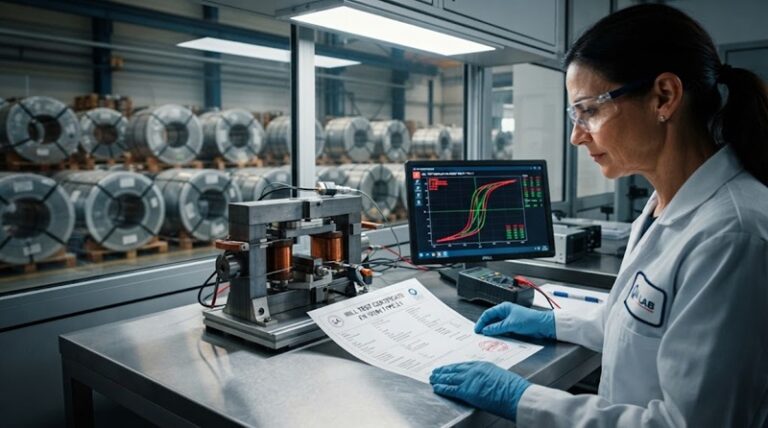
- Core Loss Testing Certification: Mandate an EN 10204 3.1 Mill Test Certificate (MTC) showing Epstein frame or Single Sheet Tester (SST) verified values for P1.5/50 or P1.7/50 and B50 values.
- Coating Type: Clarify whether the application requires heat-resistant inorganic phosphate (e.g., C-5 for transformers) or semi-organic coating for motor laminations.
- Rust-Proof Export Packaging: Electrical steel is sensitive to moisture and condensation. Require heavy-duty seaworthy packing—including VCI anti-rust paper, desiccant pouches, inner/outer steel protective corner rings, and vertical (Eye-to-Sky) or horizontal (Eye-to-Wall) strapping on fumigated hardwood skids.
For factory-direct technical consultations, custom slitting schedules, or immediate grade inquiries, you can contact Megatop Group’s engineering and sales team.
Frequently Asked Questions (FAQ)
Generally no. While CRGO could theoretically provide low losses in the narrow segments aligned with the rolling axis, the sections situated at 45° and 90° would experience severe magnetic reluctance, resulting in extreme overheating, torque ripple, and high energy consumption. For rotating machinery, CRNGO is the mandatory choice.
Hi-B (High-Permeability Grain-Oriented) steel achieves a tighter crystal alignment (grain orientation deviation within 3°, compared to 7° in conventional CGO). This allows Hi-B grades to operate at higher flux densities (B8 ≥ 1.90 T) with approximately 10% – 15% lower specific core loss.
From an electromagnetic loss perspective, thinner laminations (e.g., 0.20 mm vs 0.50 mm) substantially reduce eddy current losses, especially at higher frequencies. However, thinner laminations require more stamped sheets to achieve the same core stack height, increasing manufacturing time, stamping costs, and slightly reducing the core stacking factor (lamination factor).
References and Authoritative Standards
- IEC 60404-8-7: Magnetic materials – Part 8-7: Specifications for individual materials – Cold-rolled grain-oriented electrical steel strip and sheet delivered in the fully-processed state. International Electrotechnical Commission. https://webstore.iec.ch/publication/2034
- IEC 60404-8-4: Magnetic materials – Part 8-4: Specifications for individual materials – Cold-rolled non-oriented electrical steel strip and sheet delivered in the fully-processed state. International Electrotechnical Commission. https://webstore.iec.ch/publication/2031
- ASTM A677 / A677M: Standard Specification for Nonoriented Electrical Steel Fully Processed Types. ASTM International. https://www.astm.org/a0677_a0677m-16.html
- ASTM A876 / A876M: Standard Specification for Flat-Rolled, Grain-Oriented, Silicon-Iron, Electrical Steel, Fully Processed Types. ASTM International. https://www.astm.org/a0876_a0876m-17.html
- U.S. Department of Energy (DOE): Energy Conservation Program: Energy Conservation Standards for Distribution Transformers (10 CFR Part 431). Federal Register. https://www.energy.gov/eere/buildings/appliance-and-equipment-standards-program
- IEEE Power & Energy Society (PES): Transformer Committee Guidelines on Core Materials and Loss Evaluation (IEEE Std C57.12.00). IEEE Xplore. https://ieeexplore.ieee.org/
- World Steel Association: Steel in Energy Applications: High-Efficiency Electrical Steel Development. Worldsteel Policy Papers. https://worldsteel.org/