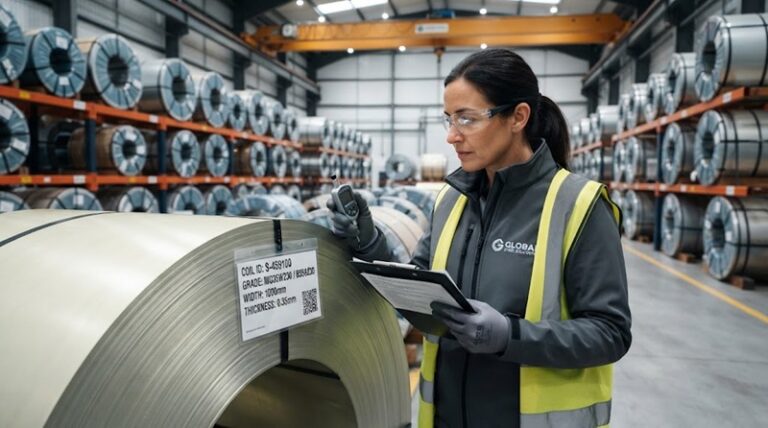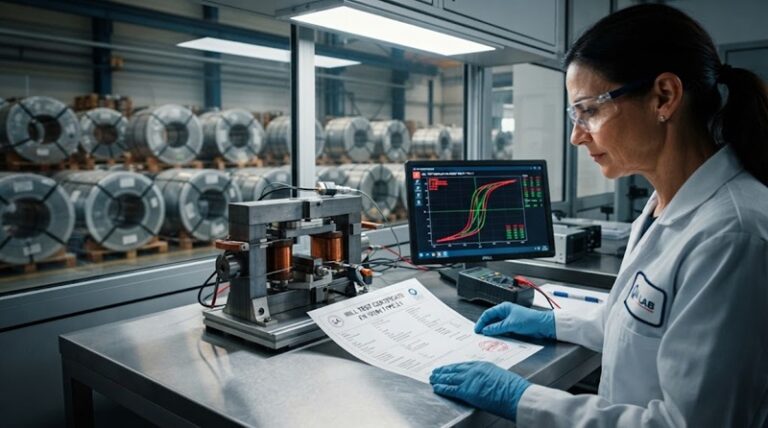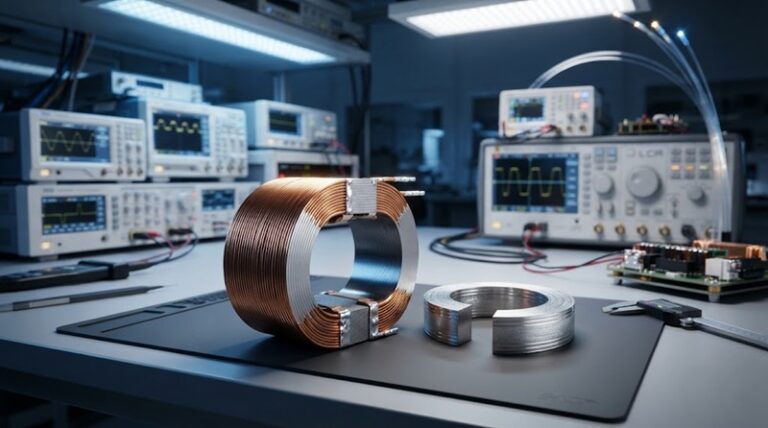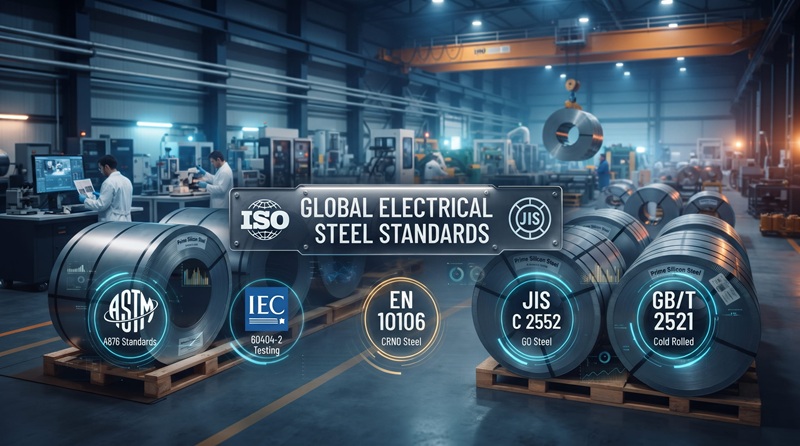
Navigating global electrical steel specifications is one of the most critical challenges facing transformer manufacturers, motor designers, and global procurement teams. Because different countries adhere to distinct national standards—such as ASTM in the United States, EN in Europe, JIS in Japan, and GB/T in China—specifying equivalent grades across international supply chains often creates confusion and costly engineering delays.
Whether you are replacing an obsolete regional grade, sourcing cost-effective mill-direct coils, or designing electromagnetic equipment for global export compliance, understanding international cross-references is essential. Below is the definitive engineering guide to decoding global electrical steel standards and cross-referencing CRGO (grain-oriented) and CRNGO (non-oriented) silicon steel grades, supported by technical metallurgical data from Megatop Group’s electrical steel catalog.
How Do Global Electrical Steel Standards Differ Across ASTM, EN, JIS, and GB/T?
Major global electrical steel standards differ primarily in their testing frequencies (50 Hz in Europe and Asia versus 60 Hz in North America), magnetic flux test points, and the syntax used to encode nominal thickness and maximum guaranteed core loss.
Every industrial region has formulated its own regulatory framework to classify electrical steel based on standardized electromagnetic testing (typically Epstein Frame or Single Sheet Tester methods):
- ASTM (North America – ASTM A677, A876, A683): Governed by ASTM International. Non-oriented grades are tested at 60 Hz and 1.5 Tesla, while grain-oriented grades are evaluated at 60 Hz and 1.5 T or 1.7 T. Iron loss is historically reported in watts per pound (W/lb) or metric watts per kilogram (W/kg).
- EN (European Union – EN 10106, EN 10107): Governed by the European Committee for Iron and Steel Standardization (ECISS). Standards mandate testing at 50 Hz. EN 10106 covers fully processed non-oriented electrical steel, while EN 10107 defines grain-oriented sheets.
- IEC (International – IEC 60404 Series): The international electrotechnical benchmark. Many European and Asian national standards mirror IEC 60404-8-4 (CRNGO) and IEC 60404-8-7 (CRGO).
- JIS (Japan – JIS C 2552, JIS C 2553): Published by the Japanese Standards Association. Highly regarded for precision tolerances, JIS standards test at 50 Hz and use alphanumeric codes like “A” for non-oriented and “Z” for oriented.
- GB/T (China – GB/T 2521.1, GB/T 2521.2): Governed by the Standardization Administration of China. Closely harmonized with IEC and EN standards, testing at 50 Hz using “W” (无取向 – Non-oriented) and “Q” (取向 – Grain-oriented). China represents the largest global production and consumption volume of electrical steel.
Decoding Electrical Steel Grade Codes: How to Read EN, JIS, ASTM, and GB/T Designations
Across virtually all international systems, an electrical steel grade code systematically communicates three vital specifications: the strip’s nominal thickness, its structural classification (oriented vs non-oriented), and its maximum guaranteed core loss.
Understanding the decoding logic allows engineers to identify core specifications at a glance:
1. European Standard (EN 10106 / EN 10107)
Example: M110-23P
- M: Designates Magnetic material (electrical steel).
- 110: 100 times the maximum specific total loss at 1.7 Tesla at 50 Hz (110 = 1.10 W/kg).
- 23: 100 times the nominal thickness in millimeters (23 = 0.23 mm).
- P: Indicates High-Permeability Grain-Oriented steel (“S” denotes Conventional Grain-Oriented, “A” denotes Non-Oriented).
2. Japanese Standard (JIS C 2552 / JIS C 2553)
Example: 23ZH110 (CRGO) or 50A470 (CRNGO)
- 23 or 50: 100 times nominal thickness (0.23 mm or 0.50 mm).
- Z: Grain-Oriented (from “Zorientation”). “ZH” denotes High-Permeability Hi-B CRGO. “A” denotes Non-Oriented.
- 110 or 470: 100 times maximum specific core loss (1.10 W/kg at 1.7T/50Hz for CRGO; 4.70 W/kg at 1.5T/50Hz for CRNGO).
3. Chinese National Standard (GB/T 2521)
Example: 23Q110 (CRGO) or 50W470 (CRNGO)
- 23 or 50: 100 times nominal thickness (0.23 mm or 0.50 mm).
- Q: “Qu Xiang” (取向) meaning Grain-Oriented. “QG” signifies High-Permeability or Domain Refined (Laser Scribed).
- W: “Wu Qu Xiang” (无取向) meaning Non-Oriented.
- 110 or 470: 100 times maximum guaranteed core loss (1.10 W/kg for CRGO; 4.70 W/kg for CRNGO).
Master Cross-Reference Table for CRGO (Grain-Oriented) Electrical Steel
For transformer core manufacturing, CRGO grades are classified into Conventional (CGO), High-Permeability (Hi-B), and Domain-Refined (Laser Scribed) categories across major international standards.
The following master cross-reference matrix correlates equivalent grain-oriented electrical steel grades across international standards, based on guaranteed maximum core loss tested at 50 Hz and 1.7 Tesla:
| Category | Nominal Thickness | GB/T 2521 (China) | EN 10107 (Europe) | JIS C 2553 (Japan) | ASTM A876M (USA – 50Hz Eq.) | Max Core Loss P1.7/50 (W/kg) | Min Magnetic Flux B800 (Tesla) |
|---|---|---|---|---|---|---|---|
| Laser Scribed Hi-B | 0.23 mm | 23QG085 | M085-23P | 23ZDKH85 | – | ≤ 0.85 | ≥ 1.90 |
| Laser Scribed Hi-B | 0.27 mm | 27QG090 | M090-27P | 27ZDKH90 | – | ≤ 0.90 | ≥ 1.90 |
| High-Perm (Hi-B) | 0.23 mm | 23Q110 | M110-23P | 23ZH110 | 23G040 | ≤ 1.10 | ≥ 1.88 |
| High-Perm (Hi-B) | 0.27 mm | 27Q120 | M120-27P | 27ZH120 | 27G047 | ≤ 1.20 | ≥ 1.88 |
| Standard CGO | 0.27 mm | 27Q130 | M130-27S | 27Z130 | 27G051 | ≤ 1.30 | ≥ 1.82 |
| Standard CGO | 0.30 mm | 30Q130 | M130-30S | 30Z130 | 30G054 | ≤ 1.30 | ≥ 1.82 |
| Standard CGO | 0.30 mm | 30Q140 | M140-30S | 30Z140 | 30G058 | ≤ 1.40 | ≥ 1.82 |
| Standard CGO | 0.35 mm | 35Q145 | M145-35S | 35Z145 | 35G062 | ≤ 1.45 | ≥ 1.82 |
| Standard CGO | 0.35 mm | 35Q155 | M155-35S | 35Z155 | 35G066 | ≤ 1.55 | ≥ 1.82 |
Notice for North American buyers: ASTM A876 historically rates grades at 60 Hz and 1.5 Tesla (e.g., M-4, M-5, M-6). Modern metric ASTM revisions designate grades by metric core loss at 1.7 T and 60 Hz. Because 60 Hz yields approximately 25% to 30% higher iron loss than 50 Hz, always verify testing frequency before finalizing substitution approvals.
Master Cross-Reference Table for CRNGO (Non-Oriented) Electrical Steel
For rotating machinery—ranging from ultra-thin EV traction motor laminations to heavy industrial generators—CRNGO grades are standardized based on maximum iron loss at 1.5 Tesla and 50 Hz.
The cross-reference matrix below correlates the most common non-oriented electrical steel grades available for motor stamping:
| Application Class | Thickness | GB/T 2521 (China) | EN 10106 (Europe) | JIS C 2552 (Japan) | ASTM A677 (USA – 50Hz Eq.) | Max Core Loss P1.5/50 (W/kg) | Min Magnetic Flux B5000 (Tesla) |
|---|---|---|---|---|---|---|---|
| EV Motor (Thin-Gauge) | 0.20 mm | 20W1200 | – | 20A1200 | – | ≤ 1.20 (P1.0/400) | ≥ 1.62 |
| EV Motor (Thin-Gauge) | 0.27 mm | 27W1400 | – | 27A1400 | – | ≤ 1.40 (P1.0/400) | ≥ 1.63 |
| High-Efficiency (IE4/IE5) | 0.35 mm | 35W230 | M230-35A | 35A230 | 36F145 | ≤ 2.30 | ≥ 1.66 |
| High-Efficiency (IE3/IE4) | 0.35 mm | 35W250 | M250-35A | 35A250 | 36F155 | ≤ 2.50 | ≥ 1.66 |
| Standard Industrial Motor | 0.35 mm | 35W300 | M300-35A | 35A300 | 36F180 | ≤ 3.00 | ≥ 1.68 |
| High-Efficiency IE3 Motor | 0.50 mm | 50W350 | M350-50A | 50A350 | 47F190 | ≤ 3.50 | ≥ 1.69 |
| Standard Industrial Motor | 0.50 mm | 50W470 | M470-50A | 50A470 | 47F205 | ≤ 4.70 | ≥ 1.72 |
| General Machinery Motor | 0.50 mm | 50W600 | M600-50A | 50A600 | 47F240 | ≤ 6.00 | ≥ 1.74 |
| Economy Motor & Pump | 0.50 mm | 50W800 | M800-50A | 50A800 | 47F305 | ≤ 8.00 | ≥ 1.74 |
| Small Appliances & Ballasts | 0.65 mm | 65W800 | M800-65A | 65A800 | 64F350 | ≤ 8.00 | ≥ 1.74 |
Key Conversion Nuances: 50 Hz vs 60 Hz Testing and Epstein vs SST Measurements
Direct numerical conversion between international grades requires adjusting for test frequency differences (50 Hz vs 60 Hz) and measurement apparatus geometry (25-cm Epstein Frame vs Single Sheet Tester).

When auditing mill test certificates (MTCs) or specifying foreign alternatives, keep these two metallurgical conversion rules in mind:
1. The 50 Hz to 60 Hz Frequency Multiplier
Because eddy current losses scale with the square of frequency ($f^2$) and hysteresis losses scale linearly with frequency (f), electrical steel tested at 60 Hz (standard in the USA, Canada, Mexico, Brazil, and Saudi Arabia) always exhibits higher losses than the exact same sheet tested at 50 Hz (standard in Europe, China, and most of Asia and Africa).
2. Epstein Frame vs Single Sheet Tester (SST)
The traditional 25-cm Epstein Frame (IEC 60404-2) requires strips cut in both longitudinal and transverse directions. Corner joints in the Epstein frame introduce slight localized flux distortion. In contrast, modern Single Sheet Testers (SST, IEC 60404-3) measure larger single panels without overlapping corners. Typically, SST measurements on CRGO show core losses approximately 5% to 8% lower than Epstein measurements for the same coil.
Procurement Checklist: How to Specify Equivalent Electrical Steel Grades Without Quality Loss
To successfully substitute electrical steel across different international standards, buyers must mandate dual-standard compliance on the Mill Test Certificate (MTC), specify slit edge tolerances, and confirm coating insulation resistance.
Follow these best practices when negotiating cross-border steel purchases:
- Define Dual-Standard Equivalents: When issuing a Request for Quotation (RFQ), list both your design standard and allowable equivalents (e.g., “Grade required: EN 10107 M130-27S or equivalent GB/T 2521 27Q130 / JIS C 2553 27Z130”).
- Require EN 10204 3.1 Certification: Insist that the mill supplies an authentic 3.1 certificate showing actual chemical analysis (Si, Al, C), guaranteed maximum loss, and tested magnetic flux density.
- Verify Surface Insulation Coating Standards: Match coating types across ASTM A976 and IEC 60404-1-1. For transformers requiring stress-relief annealing, ensure inorganic phosphate coating (C-5 equivalent); for motor punching, verify semi-organic coating (C-4 equivalent).
- Partner with a Flexible Direct Mill Processor: Direct mills with in-house precision slitting lines can tailor coil widths within ±0.1 mm, eliminating the need to source scarce, pre-slit widths from local traders.
If you require engineering assistance in cross-referencing regional steel grades or need immediate price quotes for prime electrical steel master and slit coils, contact the metallurgical team at Megatop Group.
Frequently Asked Questions (FAQ)
European grade M110-23P (0.23 mm thick, maximum loss 1.10 W/kg at 1.7T/50Hz) corresponds closely to ASTM A876 metric grade 23G040, or legacy conventional designation M-3 / M-4 high-permeability class.
Yes. Chinese national standards (GB/T 2521) are fully harmonized with IEC standards and test under identical parameters (50 Hz frequency, Epstein and SST methods). Top Chinese tier-1 mills produce equivalent or superior magnetic properties to historical European and Japanese benchmarks, often with tighter thickness tolerance and shorter lead times.
This reflects regional electrical grid frequencies (60 Hz in North America vs 50 Hz in Europe and most other nations). Because higher frequency increases internal core heating, North American motor designers must account for roughly 30% higher iron losses when designing electromagnetic circuits.
References and Authoritative Standards
- IEC 60404-8-7: Magnetic materials – Specifications for individual materials – Cold-rolled grain-oriented electrical steel strip and sheet delivered in the fully-processed state. International Electrotechnical Commission. https://webstore.iec.ch/publication/2034
- IEC 60404-8-4: Magnetic materials – Specifications for individual materials – Cold-rolled non-oriented electrical steel strip and sheet delivered in the fully-processed state. International Electrotechnical Commission. https://webstore.iec.ch/publication/2031
- ASTM A876 / A876M: Standard Specification for Flat-Rolled, Grain-Oriented, Silicon-Iron, Electrical Steel, Fully Processed Types. ASTM International. https://www.astm.org/a0876_a0876m-17.html
- ASTM A677 / A677M: Standard Specification for Nonoriented Electrical Steel Fully Processed Types. ASTM International. https://www.astm.org/a0677_a0677m-16.html
- BSI / CEN – EN 10106 & EN 10107: Cold rolled non-oriented and grain-oriented electrical steel sheet and strip delivered in the fully processed state. European Standards Repository. https://standards.iteh.ai/
- Japanese Standards Association (JSA): JIS C 2552 / JIS C 2553 Cold-rolled electrical steel strip and sheet. JSA Web Store. https://webdesk.jsa.or.jp/