Modern electrical distribution networks face stringent global decarbonization mandates and mandatory energy efficiency thresholds, such as the EU Ecodesign Directive (Tier 2) and U.S. Department of Energy (DOE) transformer standards. Because distribution transformers remain continuously energized 24 hours a day, 365 days a year, no-load core losses (P0) account for billions of kilowatt-hours in dissipated grid energy annually. Mitigating these losses requires transitioning beyond conventional cold-rolled grain-oriented steel to high-permeability (Hi-B CRGO electrical steel) and laser domain-refined (DR) grades, representing the peak of soft-magnetic metallurgical engineering.
Why Are Distribution Transformers Mandating Hi-B and Domain-Refined CRGO?
Distribution transformer designs mandate Hi-B and domain-refined CRGO because global regulatory standards penalize no-load core losses (P0) across 30-year operational lifespans. Upgrading core materials from conventional CRGO to high-permeability laser-scribed steel slashes iron losses by 15% to 30%, suppressing no-load excitation current and meeting strict EU Ecodesign Tier 2 and U.S. DOE efficiency limits.
Unlike power transformers that cycle between light and peak loads depending on industrial dispatch, medium- and low-voltage distribution transformers (ranging from 50 kVA pole-mounted units to 3,150 kVA pad-mounted substations) frequently operate at average load factors of only 15% to 35%. Under these partial-load conditions, load-dependent copper losses drop significantly, making continuous, load-independent no-load core loss (P0) the predominant source of lifetime energy waste.
In response, international standards bodies have enforced strict maximum allowable no-load loss limits:
- European Union (EN 50588-1 / Ecodesign Tier 2): Requires A0 and A0-10% maximum no-load loss levels, effectively banning standard-grade 0.30 mm conventional CRGO in new substation installations.
- United States (DOE 10 CFR Part 431): Mandates minimum efficiency levels evaluated at 50% load, driving utilities to deploy capitalized loss evaluation models (A and B factors) that assign steep financial penalties to core excitation losses.
- China (GB 20052-2020): Establishes Tier 1 energy efficiency benchmarks that require high magnetic polarization (B8 ≥ 1.90 T) and ultra-low loss thinner gauges (≤ 0.23 mm).
To satisfy these thresholds without increasing transformer core weight or oil tank footprint, transformer original equipment manufacturers (OEMs) rely on high-permeability grain-oriented steel with advanced surface domain treatments.
Conventional CRGO vs. Hi-B vs. Domain Refined: Metallurgical Mechanisms
The metallurgical distinction between conventional CRGO, Hi-B, and domain-refined electrical steel lies in crystal lattice orientation precision and magnetic domain wall spacing. While conventional CRGO achieves a Goss texture (110)[001] orientation misaligned by 7°–8°, Hi-B reduces this misalignment angle to under 3°, and laser domain refinement physically divides wide magnetic domains to drastically suppress dynamic eddy current dissipation.
All grain-oriented electrical steels rely on the (110)[001] Goss texture, where the easiest direction of magnetization (the [001] crystal edge) aligns parallel to the strip’s longitudinal rolling direction. However, the metallurgical processing pathways differ substantially across product tiers:
1. Conventional CRGO (CGO)
Conventional CRGO uses manganese sulfide (MnS) precipitates as secondary recrystallization grain growth inhibitors during high-temperature box annealing. The resulting grains achieve an average misorientation angle of 7° to 8° relative to the rolling vector. This yields a typical magnetic polarization at 800 A/m (B8) of approximately 1.82 to 1.85 Tesla, providing adequate performance for legacy transformers but higher anomalous core losses under 1.7 Tesla operation.
2. High-Permeability CRGO (Hi-B)
Hi-B electrical steel incorporates aluminum nitride (AlN) in conjunction with MnS (or bismuth/copper microalloying) to create stronger, more thermally stable grain boundary pinning forces. During secondary recrystallization, only grains with an almost perfect (110)[001] orientation—having a misorientation angle of less than 3°—can consume neighboring matrix grains. This tight alignment elevates B8 polarization to 1.90–1.95 Tesla. The higher saturation allows transformer designers to operate at higher working flux densities (1.65–1.72 T) without core saturation or excessive excitation current.
3. Domain Refinement (Laser Scribing & Plasma Etching)
While Hi-B maximizes permeability, its exceptionally large grain size (often 10 mm to 30 mm across) causes wide magnetic domain wall spacing. When magnetized at 50 Hz or 60 Hz, these wide 180° domain walls must traverse broad distances at high velocities, generating intense microscopic eddy currents that increase anomalous dynamic iron loss (Pexc).
Domain Refinement (DR) solves this by focusing high-energy pulsed laser beams or plasma torches across the strip transverse to the rolling direction at intervals of 3 mm to 6 mm. The rapid, localized thermal shock creates microscopic compressive and tensile stress bands in the steel surface without damaging the insulating phosphate coating. These artificial stress lines segment wide magnetic domains into narrow, parallel micro-domains. As a result, domain walls travel much shorter distances during AC magnetization, reducing anomalous eddy current losses by up to 20%–25%.
Technical Comparison: Grade Equivalents, Core Loss, and Audible Noise
Selecting the proper transformer grade requires evaluating specific iron loss at 1.7 Tesla (P1.7/50), magnetic polarization (B8), and magnetostriction acoustic behavior. Laser domain-refined 0.23 mm and 0.27 mm grades achieve core losses below 0.80 W/kg at 1.7 T, while delivering substantial acoustic noise reduction for urban substations.
| Product Category | Nominal Gauge (mm) | Megatop Grade | Loss P1.7/50 (W/kg) | Loss P1.7/60 (W/kg) | Polarization B8 (Tesla) | Audible Hum Reduction | Target Core Architecture |
|---|---|---|---|---|---|---|---|
| Conventional CRGO | 0.30 mm | MG30Q120 | 1.15 – 1.25 | 1.50 – 1.63 | 1.83 – 1.85 | Baseline (0 dB) | Legacy Distribution Units, Agricultural Grids |
| Conventional CRGO | 0.27 mm | MG27Q110 | 1.05 – 1.15 | 1.38 – 1.50 | 1.84 – 1.86 | -1.0 dB | Standard Rural Distribution Transformers |
| Standard Hi-B | 0.27 mm | MG27Q095 | 0.90 – 0.98 | 1.18 – 1.28 | 1.90 – 1.92 | -2.5 dB | Industrial Pad-Mounted Transformers |
| Standard Hi-B | 0.23 mm | MG23Q085 | 0.82 – 0.88 | 1.08 – 1.16 | 1.91 – 1.93 | -3.5 dB | High-Efficiency Tier 2 Substation Transformers |
| Domain-Refined (DR) | 0.27 mm | MG27Q090-DR | 0.85 – 0.92 | 1.11 – 1.20 | 1.91 – 1.93 | -3.0 dB | Step-Lap Mitred Stacked Cores (No Anneal) |
| Domain-Refined (DR) | 0.23 mm | MG23Q080-DR | 0.74 – 0.80 | 0.97 – 1.05 | 1.92 – 1.94 | -4.5 dB | Ultra-Quiet Urban Substations & Tier 2 Units |
| Ultra-Thin Domain-Refined | 0.20 mm | MG20Q070-DR | 0.66 – 0.72 | 0.86 – 0.94 | 1.93 – 1.95 | -5.5 dB | Flagship Renewable Inverter Step-Up Cores |
Table 1: Comprehensive magnetic, loss, and acoustic specifications of conventional, Hi-B, and laser domain-refined electrical steel grades for transformer manufacturing.
Transformer acoustic noise is primarily generated by magnetostriction—the minute dimensional expansion and contraction of core laminations under alternating magnetic fields—and interlaminar electromagnetic Maxwell forces. Because Hi-B steel grains are precisely aligned with the rolling axis, transverse magnetostrictive deformation is suppressed, reducing core vibration and audible humming by 2 to 5 dB(A). This noise reduction is critical for transformers installed inside commercial buildings or densely populated residential neighborhoods.
Review our complete specifications for high-performance electrical steel products to match your core geometry requirements.
Mitred Stacking, Step-Lap Joints, and Building Factor (BF) Optimization
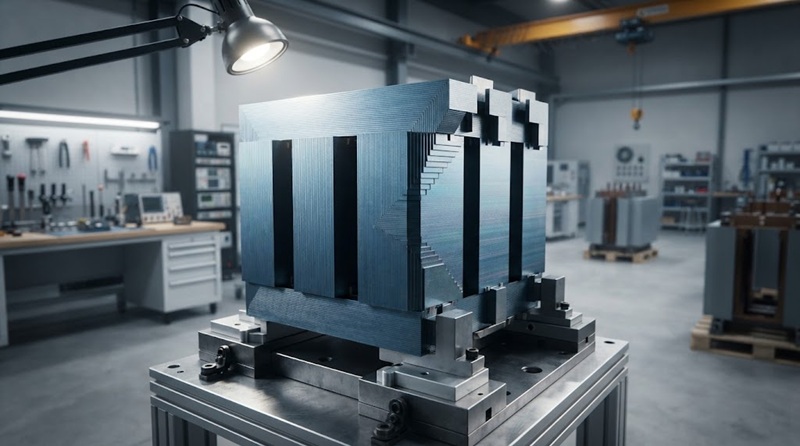
Achieving target core losses in finished transformers requires minimizing the Building Factor (BF) through precision step-lap mitred joints and controlled clamping pressure. Upgrading from simple 45° mitre joints to multi-step-lap stacking (3-step or 5-step) eliminates localized air-gap flux crowding, reducing the building factor from 1.25 down to 1.08–1.12.
The Building Factor (BF), also known as the Destruction Factor, is the ratio of the measured iron loss in the assembled transformer core (Pcore) to the theoretical Epstein or single-sheet tester loss guaranteed by the steel manufacturer (Pnominal):
Building Factor (BF) = Pcore / Pnominal
A higher building factor means that mechanical handling, shearing, and joint geometry have degraded the steel’s magnetic performance. Key engineering measures to lower building factor include:
- Multi-Step-Lap Mitred Joint Geometry: In standard 45° mitred joints, magnetic flux lines crossing from the core limb into the yoke encounter air gaps, forcing flux to jump across laminations perpendicular to the rolling direction. This cross-flux induces severe localized eddy currents. In a 5-step or 6-step-lap joint, lamination edges overlap in staggered steps (3.5 mm to 5.0 mm offsets), providing a continuous bridge of low-reluctance magnetic pathways that reduces corner joint losses by over 40%.
- Mechanical Clamping Pressure Control: Grain-oriented electrical steel is sensitive to mechanical compression. Clamping pressures exceeding 0.4 to 0.6 MPa along the lamination plane induce compressive stresses that amplify magnetostriction and double localized hysteresis losses. Banding systems using resin-impregnated fiberglass tape or non-magnetic tie rods must distribute clamping loads evenly.
- Precision Shearing Burr Minimization: Slitting and mitre cutting must maintain burr heights strictly below 5 μm. Elevated burrs bridge the inorganic surface coating (AISI C-5 / Carlite), establishing interlaminar conductive paths that cause circulating eddy currents across the core limb.
Total Cost of Ownership (TCO) and Loss Capitalization (A and B Factors)
Utility procurement evaluates distribution transformers using Total Cost of Ownership (TCO) capitalization formulas, assigning heavy financial penalties (A-factor) to no-load core losses compared to load losses (B-factor). Investing in premium Hi-B and domain-refined CRGO yields rapid financial payback, as every watt of avoided core loss saves between $4.00 and $10.00+ in capitalized utility expenditure over 30 years.
Power utilities and infrastructure operators procure distribution assets based on life-cycle cost rather than initial purchase price alone. The universal capitalization formula is structured as:
TCO = Purchase Price + (A × P0) + (B × Pk)
Where:
- P0: Measured no-load core loss in Watts.
- Pk: Measured load loss (winding resistance loss) in Watts at rated current.
- A-factor ($/Watt): Capitalized cost of supplying continuous no-load losses over 30 years (typically $4.00 to $12.00/W depending on regional electricity tariffs and interest rates).
- B-factor ($/Watt): Capitalized cost of supplying load-dependent losses (typically $1.00 to $3.50/W).
Consider a 1,000 kVA distribution transformer operating under an evaluation rate where A = $8.00/W. Upgrading the core from conventional 0.27 mm CRGO (P0 ≈ 1,350 W) to 0.23 mm Laser Domain-Refined Hi-B (P0 ≈ 980 W) saves 370 Watts of continuous no-load dissipation:
Capitalized Core Savings = 370 W × $8.00/W = $2,960 USD
This capitalized operating expenditure ($2,960) significantly outweighs the modest raw material price premium of high-grade domain-refined steel, delivering a compelling economic return for grid operators and industrial end-users.
For specialized transformer core applications, compare these performance characteristics against rotating machinery materials in our guide to non-grain oriented electrical steel (CRNGO).
Frequently Asked Questions (FAQ) About Transformer Electrical Steel
Can laser domain-refined (DR) electrical steel be stress-relief annealed?
Standard laser-scribed domain-refined CRGO is non-heat-proof. If annealed at typical stress-relief temperatures (750°C to 820°C), the localized laser-induced thermal stress fields are relieved, erasing the artificial domain wall divisions and causing the steel to revert to standard unrefined Hi-B loss levels. Therefore, non-heat-proof DR steel is strictly designed for stacked cores assembled directly without post-weld or post-shearing annealing. However, modern steelmakers also produce heat-proof domain-refined steel created via physical surface grooving (chemical etching or mechanical micro-indentation), which retains domain-refining properties even after stress-relief annealing.
What is the difference between wound core and stacked core transformer designs?
Wound core (or strip-wound toroidal) transformers wind continuous ribbons of electrical steel around circular or rectangular mandrels, eliminating mitred corner joints and air gaps entirely to achieve building factors close to 1.0. However, wound cores require stress-relief annealing after forming to remove winding bending stresses, necessitating heat-proof CRGO grades. In contrast, stacked core transformers are built from individual mitred laminations stacked in step-lap configurations, which accommodate non-heat-proof laser-scribed Hi-B grades without requiring secondary heat treatment.
How does lamination thickness impact higher harmonic core losses in solar and wind transformers?
Step-up transformers connected to solar PV inverters and wind turbine converters operate under high harmonic distortion caused by grid-tied power electronics. Higher harmonic frequencies (such as the 5th, 7th, 11th, and 13th orders) drastically amplify eddy current losses. Thin-gauge Hi-B steel (such as 0.20 mm or 0.23 mm) suppresses these frequency-dependent eddy currents far more effectively than 0.30 mm steel, preventing excessive internal core heating and protecting transformer insulation oil from thermal degradation.
Authoritative Technical References & Standards
- International Electrotechnical Commission (IEC): IEC 60404-8-7: Magnetic materials – Part 8-7: Specifications for grain-oriented electrical steel strip and sheet.
- European Committee for Electrotechnical Standardization (CENELEC): EN 50588-1: Medium power transformers 50 Hz with highest voltage not exceeding 36 kV – Ecodesign requirements.
- IEEE Power and Energy Society: IEEE C57.12.00: Standard for General Requirements for Liquid-Immersed Distribution, Power, and Regulating Transformers.
- U.S. Department of Energy (DOE): 10 CFR Part 431, Subpart K: Energy Conservation Standards for Commercial Distribution Transformers.
- ASTM International: ASTM A876 / A876M: Standard Specification for Flat-Rolled, Grain-Oriented, Silicon-Iron, Electrical Steel, Fully Processed Types.
- CIGRE Technical Council: CIGRE Working Group A2.53: Advances in Transformer Core Technology, Losses and Sound Optimization.
Looking for certified Hi-B or domain-refined master coils slit to your exact step-lap dimensions? Discover how Megatop Group delivers global metallurgical precision or request a fast technical quotation from our engineering team.