Electric motors consume approximately seventy percent of all industrial electrical power worldwide. Consequently, international energy mandates now enforce rigorous minimum efficiency standards. Specifically, industrial equipment must comply with IE3, IE4, and emerging IE5 efficiency classifications. To meet these targets, rotating machinery manufacturers must optimize their magnetic cores. Selecting premium non-grain-oriented electrical steel (CRNGO) is essential. This technical guide examines metallurgical selection for large industrial motors and utility-scale generators.
Why Do IE4 and IE5 Industrial Motors Require Upgraded CRNGO Steel?
Industrial electric motors mandate low-loss CRNGO steel to comply with global IE3, IE4, and IE5 efficiency standards. Specifically, upgraded silicon steel minimizes internal core loss while preserving high magnetic saturation. As a result, modern drive systems achieve superior operating efficiency without enlarging motor frame dimensions.
The International Electrotechnical Commission established the IEC 60034-30-1 efficiency standard. This framework defines four efficiency classes: Standard (IE1), High (IE2), Premium (IE3), and Super Premium (IE4). Furthermore, the upcoming Ultra-Premium (IE5) tier lowers internal losses even further.
Traditionally, manufacturers built standard industrial motors using low-grade electrical steels. These legacy materials exhibited core losses exceeding 5.0 W/kg at 1.5 Tesla. However, such grades generate excessive heat within continuous-duty industrial pumps and compressors.
In contrast, modern IE4 motors require high-grade, fully processed CRNGO laminations. Upgrading the stator core reduces no-load losses by twenty to thirty percent. Consequently, the motor runs cooler during continuous full-load factory operations. This thermal reduction also extends winding insulation life substantially.
In addition, industrial users achieve rapid financial payback through lowered utility bills. For example, a 110 kW motor operates thousands of hours each year. Therefore, every fractional efficiency gain saves significant operational expenditure over time.
The Core Dilemma: Balancing Magnetic Saturation (B50) and Core Loss (P1.5/50)
Industrial motor design demands an optimal balance between low iron loss and high magnetic saturation. Adding silicon reduces core loss effectively by increasing electrical resistivity. However, each additional percentage of silicon decreases magnetic saturation, requiring higher magnetizing current in motor teeth.
In rotating electrical machines, magnetic flux travels through complex geometries. Specifically, flux passes through narrow stator teeth into the circular stator back-iron. Within the stator teeth, localized magnetic flux density often reaches 1.6 to 1.8 Tesla.
Metallurgists add silicon (Si) and aluminum (Al) to increase electrical resistivity. Consequently, circulating eddy current losses drop significantly. However, silicon displaces magnetic iron atoms within the crystalline lattice. As a result, each one weight percent of silicon reduces saturation magnetization by roughly 0.05 Tesla.
This physical tradeoff introduces serious engineering challenges for motor designers:
- High-Silicon Steel (>3.0 wt% Si): Delivers exceptional core loss reduction. However, lower magnetic polarization increases the required magnetizing current in saturated teeth.
- Medium-Silicon Steel (1.8 to 2.5 wt% Si): Provides higher magnetic polarization (B50 ≥ 1.68–1.72 T). Thus, it maintains high torque density while preventing winding copper loss spikes.
If stator teeth saturate prematurely, the motor draws excess reactive magnetizing current. Consequently, copper resistive heating (I2R loss) increases rapidly. This added copper heating can completely negate the iron loss savings gained from higher silicon steel.
Therefore, engineers must select grades that optimize both parameters simultaneously. Review our complete portfolio of high-efficiency electrical steel grades to evaluate balanced options.
Technical Comparison: Industrial CRNGO Grades for Motors and Generators
Selecting the proper electrical steel grade depends on operating frequency, motor size, and target efficiency class. Thinner 0.35 mm laminations excel in high-pole and inverter-fed motors. Meanwhile, high-permeability 0.50 mm grades deliver optimal magnetic saturation and stamping economy for large grid-connected industrial machines.
| Nominal Gauge (mm) | Megatop Grade | Max Core Loss P1.5/50 (W/kg) | Max Core Loss P1.5/60 (W/kg) | Min Polarization B50 (Tesla) | Stacking Factor (kfe) | Target Application & Efficiency |
|---|---|---|---|---|---|---|
| 0.50 mm | MG50W290 | 2.90 | 3.70 | 1.70 | ≥ 97.0% | Standard IE3 Industrial Pumps & Compressors |
| 0.50 mm | MG50W270 | 2.70 | 3.45 | 1.71 | ≥ 97.0% | High-Performance IE4 Fixed-Speed Induction Motors |
| 0.50 mm | MG50W250 | 2.50 | 3.20 | 1.69 | ≥ 97.0% | Flagship IE4 Industrial Motors & Hydro Generators |
| 0.35 mm | MG35W230 | 2.30 | 2.95 | 1.68 | ≥ 96.5% | IE4/IE5 Inverter-Duty Drives & Turbogenerators |
| 0.35 mm | MG35W210 | 2.10 | 2.70 | 1.67 | ≥ 96.5% | Ultra-Premium IE5 Synchronous Reluctance Motors |
Table 1: Metallurgical specifications and magnetic performance of industrial CRNGO electrical steel grades.
For standard line-operated 50 Hz or 60 Hz motors, 0.50 mm steel remains the workhorse. It offers an excellent balance of material cost, mechanical rigidity, and high stacking factor. Furthermore, high magnetic polarization (B50 ≥ 1.70 T) keeps the stator outer diameter compact.
However, variable frequency drive (VFD) motors generate high-frequency inverter harmonics. Under these harmonic conditions, eddy current losses increase noticeably. Consequently, transitioning to 0.35 mm electrical steel (such as MG35W230) provides superior high-frequency performance.
Segmented Stators in Large Hydro and Turbogenerators: Stacking and Clamping
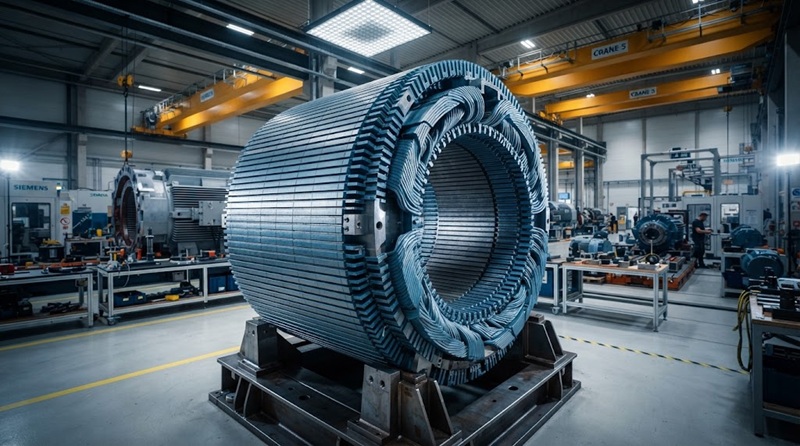
Large utility-scale turbogenerators and hydro generators utilize segmented stator laminations rather than continuous rings. Because stator diameters exceed three to ten meters, precision dovetailed segments are stamped and stacked in overlapping layers. This segmented construction requires exceptional steel flatness, tight thickness tolerances, and minimal punching burrs.
In power station generators, complete circular stator laminations cannot be punched from single coils. Steel strip widths are physically limited to roughly 1,200 mm to 1,250 mm. Therefore, manufacturers divide large stator rings into multiple interlocking circular segments.
During core building, workers stack these segments around heavy structural keybars. Each layer is staggered relative to the previous layer. Consequently, this overlapping pattern eliminates continuous radial air gaps throughout the generator back-iron.
Successful segmented core manufacturing requires strict metallurgical controls:
- Tight Strip Crown Tolerances: Thickness variation across the master coil width must remain under 3 μm. In a five-meter-long generator core, uneven thickness causes core waviness and axial distortion.
- Strict Burr Control: Segment punching burr heights must not exceed 5 μm. Excessive burrs penetrate surface coatings, creating massive circulating interlaminar fault currents.
- Low Internal Residual Stress: Sheets must exhibit superior flatness after slitting. Internal residual stress causes segments to twist, preventing precise dovetail alignment on generator keybars.
In addition, large generators incorporate radial cooling ducts between core packets. High clamping pressures compress the entire assembly axially. Therefore, the steel must withstand sustained mechanical compression without coating breakdown.
Surface Insulation Coatings: Choosing Between C-4, C-5, and C-6 for Heavy Industry
Selecting the correct surface insulation coating is critical for preventing interlaminar short circuits under high operating voltages. While organic C-3 coatings suit light appliances, severe industrial machinery requires inorganic C-4 or hybrid C-5 coatings. These advanced coatings offer exceptional electrical resistance, temperature stability, and chemical resistance against cooling fluids.
Interlaminar voltage accumulates across the height of large magnetic cores. If insulation degrades, eddy currents circulate freely across adjacent laminations. Consequently, localized hot spots emerge, which can trigger catastrophic core burning.
The American Iron and Steel Institute (AISI) classifies electrical steel coatings systematically:
- AISI C-4 (Inorganic Coating): Formulated with metal phosphates and silicates. It withstands high-temperature stress-relief annealing (up to 800°C) without burning. However, its tool-lubricating properties are modest.
- AISI C-5 (Inorganic-Organic Hybrid): Our recommended standard for industrial machines. C-5 combines inorganic phosphate binders with organic resins. It provides high surface resistivity (>50 Ω·cm2), excellent punchability, and high corrosion protection.
- AISI C-6 (Heavy-Duty Organic Coating): A thick, pigmented organic polymer film. It provides maximum punchability and superior chemical resistance. However, it cannot withstand high-temperature annealing.
For large high-voltage motors, C-5 coatings deliver the best performance balance. They resist modern synthetic lubricating oils and automatic transmission fluids reliably. Learn more about how Megatop Group ensures coil coating consistency across all production runs.
Frequently Asked Questions (FAQ) About Industrial Motor Electrical Steel
How does switching from 0.50 mm to 0.35 mm CRNGO affect motor manufacturing costs?
Switching from 0.50 mm to 0.35 mm steel increases production costs moderately. First, thin-gauge electrical steel carries a raw material price premium. Second, building the same core height requires forty-three percent more laminations. Consequently, stamping die cycles increase, and tool maintenance intervals shorten. However, for inverter-driven IE4 and IE5 motors, the substantial iron loss reduction easily justifies these initial manufacturing costs.
Why is magnetic saturation (B50) more critical in industrial motors than in transformers?
Power transformers operate with closed magnetic circuits containing no intentional air gaps. In contrast, electric motors contain an essential physical air gap between the stator and rotor. Crossing this mechanical air gap requires significant magnetizing force. Therefore, motor steels must possess high magnetic polarization (B50). High polarization limits reactive current draw, improving the motor’s operating power factor.
Can CRGO electrical steel be utilized in large utility turbogenerators?
Standard circular motor stators require non-oriented CRNGO steel because magnetic flux rotates in all directions. However, large utility turbogenerators occasionally use grain-oriented CRGO electrical steel in their segmented stator construction. In these specialized machines, engineers orient the rolling direction along the stator back-iron. This technique exploits CRGO’s ultra-low loss along the circumferential magnetic flux path.
Authoritative Technical References & Standards
- International Electrotechnical Commission (IEC): IEC 60034-30-1: Rotating electrical machines – Part 30-1: Efficiency classes of line-operated AC motors (IE code).
- IEEE Industry Applications Society: IEEE Standard 841: Standard for Petroleum and Chemical Industry – Premium-Efficiency Severe-Duty Induction Motors.
- National Electrical Manufacturers Association (NEMA): NEMA MG 1: Motors and Generators – Standards and Testing Methods.
- ASTM International: ASTM A677: Standard Specification for Non-Grain-Oriented Electrical Steel Fully Processed Types.
- U.S. Department of Energy (DOE): Energy Conservation Standards for Commercial and Industrial Electric Motors.
- Worldsteel Association: Electrical Steel Market Trends: Supporting Next-Generation Industrial Energy Efficiency.
Need certified industrial-grade CRNGO coils or precision slit widths for your motor manufacturing lines? Contact Megatop Group’s technical team today to request material data sheets or custom price quotations.